Aggie First Response 8+1 (concept design)
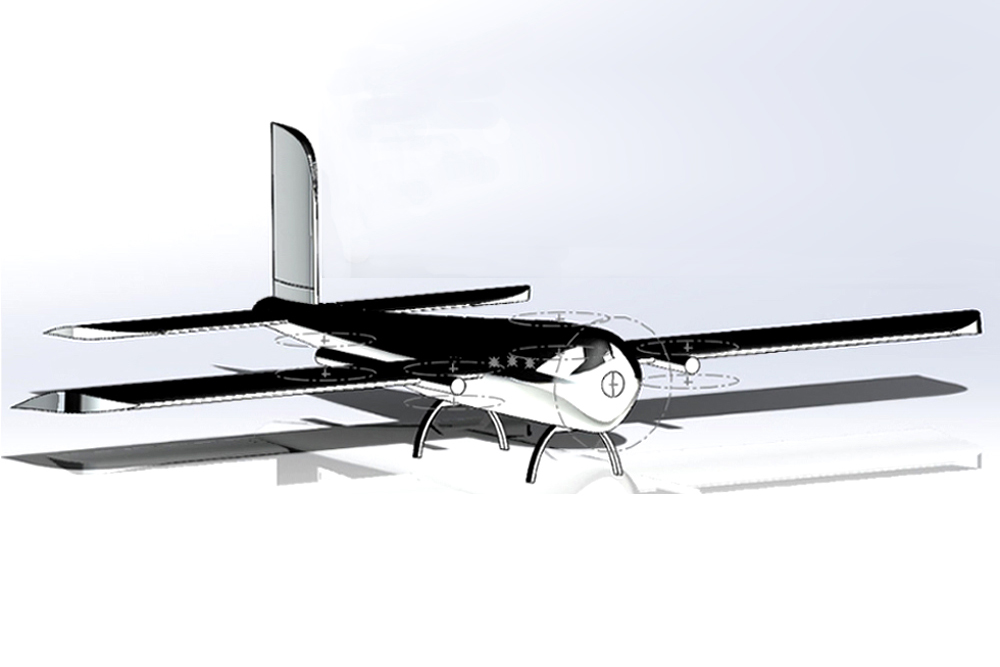
(Image credit: Aggie First Response, North Carolina Agricultural and Technical State University )
8+1 Composite Quad-plane for Long Range Missions (concept design)
Aggie First Response
North Carolina Agricultural and Technical State University (N.C. A&T University)
Greensboro, North Carolina, USA
www.ncat.edu
Founded in 1891, North Carolina Agricultural and Technical State University is a public land-grant doctoral higher research university in Greensboro, North Carolina, United States. Dedicated to learning, discovery and community engagement, the university provides a wide range of educational opportunities from bachelor’s to doctoral degrees in both traditional and online environments. With an emphasis on preeminence in STEM and a commitment to excellence in all its educational, research, and outreach programs, North Carolina Agricultural and Technical State University fosters a climate of economic competitiveness that prepares students for the global society.
North Carolina Agricultural and Technical State University is also known as North Carolina A&T State University, North Carolina A&T and N.C. A&T University and N.C. A&T.
Team Members
Aggie First Response's Team Lead is Luis Landivar and the team includes Team Members Amilia Schimmel, Abhijit Shinde, Maria Olmos, Ansumana Fofana and Dr. Zhijian Xie. The goal of the team was to create an aircraft that can respond more effectively and efficiently than helicopters, drones and ambulances in times of natural and man-made disasters, extreme weather catastrophes and medical emergencies. The team is a GoAERO Stage 1 award winner in 2025 and was one of 14 NASA University Innovation Award winners. The team's new type of aircraft that could be used for the nascent advanced air mobility (AAM) industry.
Team Motivation
Some of the team members where motivated to participate in the GoAERO prize due living near the Appalachian Mountains of North Carolina and seeing people losing their lives due to natural disasters such as flooding, forest fires, landslides or mountain falls. One team member from India saw first hand, a devastating flood in his hometown that affected nearly three million people but rescue teams couldn't deliver water, food, medicine and other emergency items for 15 days due to flooded roads and bridges and the absence of nearby airlifting facilities.
"8+1 Composite Quad-plane for Long Range Missions" passenger rescue eVTOL aircraft (concept design)
The name of the concept design aircraft is the "8+1 Composite Quad-plane for Long Range Missions". The 8+1 is an autonomous long-range rescue passenger eVTOL aircraft. Because the aircraft has no cockpit, the fuselage looks almost drone-like and the aircraft design slightly resembles a Focke-Wulf Fw 190 or a Fairchild PT-19 but with a mid wing. While the 8+1 concept design is intended to use battery packs, the team stated if a full-scale aircraft would be made, it would have a hybrid-electric power source.
The 8+1 eVTOL aircraft has one tractor propeller for forward flight, eight stacked VTOL-only propellers and is powered by battery packs. The VTOL propellers are positioned close to the fuselage. The aircraft has been designed with one main mid wing and has a standard airplane tail. The fuselage is made from carbon fiber composite to give the aircraft a high strength to low weight ratio. The aircraft has fixed quadricycle struts for its landing gear.
Team's Goals For The 8+1 Rescue Aircraft
One of the first ideas of the team was to incorporate a thermal color imaging system to identify and distinguish humans from animals on the ground and to gather this information that would be relayed to first responders. The team also worked with first responders on the design of the aircraft and began asking for other features for the aircraft such as night vision and full-color thermal imaging.
The team's goal is to have the aircraft autonomously fly to a rescue zone, detect where people are in need of assistance and relay their locations to first responders. If injured people are inaccessible by on-the-ground vehicles, by foot or by horseback, the aircraft would be able to pick them up and fly them to safety. An additional design feature was to make the aircraft heat resistant allowing it to fly near wildfires without extreme heat disabling the aircraft. Further, the team wanted to add technology that would counteract cybersecurity threats and prevent hacking that would stop the aircraft's functions and objectives.
About the GoAERO Prize Competition
The GoAERO Prize, sponsored by Boeing, is a three year competition (2024-2027) offering over $2 million USD in prizes that challenges engineers worldwide to create portable, versatile and autonomy-enabled Emergency Response Aircraft that address not only everyday medical emergencies but also to be used in natural disasters, humanitarian emergencies and climate crises worldwide. Each team designs and builds autonomous Emergency Response aircraft capable of delivering a first responder, medical equipment and supplies and ultimately evacuating victims in need to a rescue ambulance or hospital.
More than 150 teams from around the globe are competing for the GoAero prizes. The GoFly and GoAERO prizes were developed by Boeing and other organizations to help the nascent advanced air mobility (AAM) industry move forward.
Specifications:
- Aircraft type: Long-range passenger rescue eVTOL plane (concept design)
- Piloting: Autonomous piloting
- Capacity: 1 passenger or patient
- Cruise speed: Unknown
- Maximum payload weight: ~300 lb (136 kg)
- Propellers: 1 tractor propeller (for forward flight), 8 stacked VTOL-only propellers
- Electric motors: 9 electric motors
- Power source: Battery packs
- Fuselage: Carbon fiber composite
- Wings: 1 main mid wing
- Tail: 1 stand tail
- Landing gear: Fixed strut landing gear
- Safety features: Distributed Electric Propulsion (DEP) uses multiple propellers or electric ducted fans, each powered by electric motors, to increase safety through redundancy. If one or more components fail, the remaining ones can still ensure a safe landing. There are also redundancies of critical components in the sub-systems of the aircraft providing safety through redundancy. Having multiple redundant systems on any aircraft decreases having any single point of failure.
Resources:
- North Carolina Agricultural and Technical State University website
- North Carolina Agricultural and Technical State University Facebook
- North Carolina Agricultural and Technical State University Instagram
- North Carolina Agricultural and Technical State University YouTube
- North Carolina Agricultural and Technical State University X (Formerly Twitter)
- North Carolina Agricultural and Technical State University LinkedIn
- North Carolina Agricultural and Technical State University Wikipedia
- Article: GoAERO Launches $2M+ VTOL Challenge, Electric VTOL News, Feb. 12, 2024
- Article: Aggie First Response - NC A&T University, GoAero, Feb. 2025
- Article: Stage 1 Winners, GoAero, Feb. 2025
- Article: GoAERO Announces Eleven Stage 1 Winners, Aero News Network, Feb. 16, 2025
- Article: GoAERO Global Emergency Response Flyer Competition Announces $500,000 of Awards to Innovators Worldwide with Support from Boeing, NASA, RTX, and Honeywell, GoAERO, Feb. 18, 2025
- Article: GoAERO Awards $500,000 to Stage 1 Teams, Vertiflite Magazine, Mar/Apr 2025
- Article: Meet the Teams: Aggie First Response of North Carolina A&T State University, GoAero, May 8, 2025

Recent Pages
- SMD Shenzhen Smart Drone UAV Bullet (production model)
- DreamFly Aerotech DF3000 Youlong (prototype)
- aeroG Aviation AG-8 (concept design)
- NASA Tiltwing-Two (illustration)
- CoolFly Urban 4 (concept design)
- CoolFly Standing Flight Platform (prototype)
- CoolFly Urban 3 (prototype)
- CoolFly Urban 2 (concept design)
- CoolFly Urban (production model)
- CoolFly Dream ST (production model)