Tatsumi Huam Earthquake Rescue (concept design)
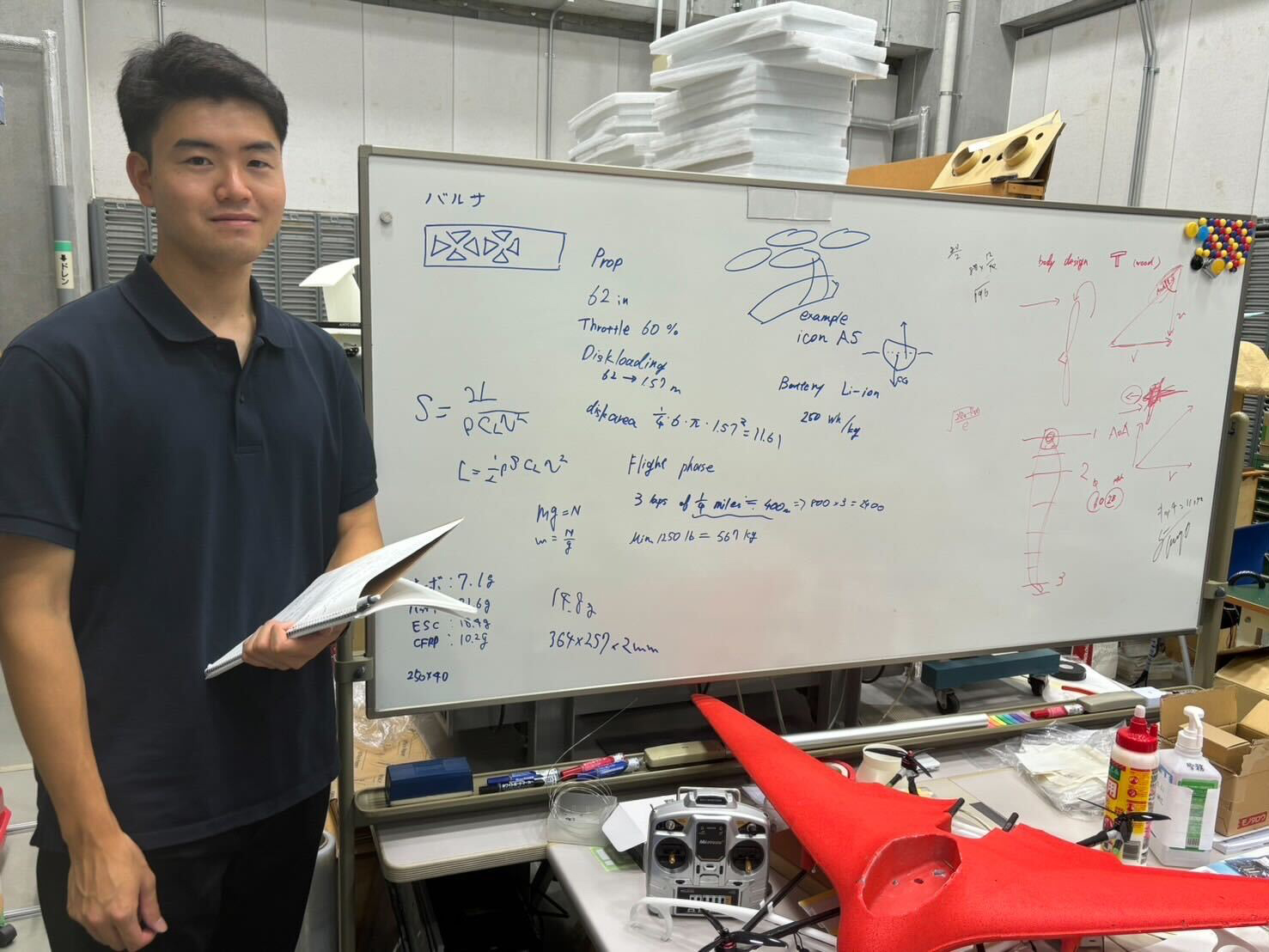
(Photo credit: Tomohiro Tatsumi)
Huam Earthquake Rescue (concept design)
Tatsumi
Japan
website unknown
Tomohiro Tatsumi is the Team Lead for Team Huam in the GoAERO competition (2024-2027). Tatsumi designed and made a subscale prototype emergency response electric vertical takeoff and landing (eVTOL) aircraft for the GoAERO competition. Although the team was not selected as a Stage 1 or Stage 2 prize winner, the project demonstrated the team's approach to an emergency response eVTOL aircraft design for advanced air mobility (AAM).
When Tatsumi was 11 years old when he experienced first-hand Japan's 2011 Tōhoku earthquake and tsunami, a 9.0-9.1 megathrust earthquake, that caused a massive tsunami in the Pacific Ocean which killed 22,312 people. Since Tatsumi lives in Japan, the land of earthquakes, Tatsumi is focusing on making an emergency rescue eVTOL aircraft to help save people during dangerous Japanese earthquakes.
Tatsumi began learning about designing and building eVTOL aircraft with an internship at HIEN Aero Technologies. He has also studied from the book, Aircraft Design–A Conceptual Approach by Daniel P. Raymer as a graduate student at Hosei University (Japan).
Huam Earthquake Rescue is an emergency rescue passenger eVTOL aircraft (concept design)
The Huam Earthquake Rescue is an autonomous emergency rescue passenger eVTOL aircraft. The multicopter has the capability to fly into unknown complex dangerous rescue zones that helicopters may or may not be able to fly into, to rescue earthquake victims.
The eVTOL aircraft has four VTOL-only propellers, one pusher propeller, five electric motors and is powered by Lithium-ion battery packs. The concept design has one Delta wing and the passenger sits in the front middle of the Delta wing. The fuselage is made from carbon fiber composite to give the aircraft a high strength to low weight ratio. The aircraft will have fixed tricycle wheeled landing gear.
About the GoAERO Prize Competition
The GoAERO Prize, sponsored by Boeing, is a three year competition (2024-2027) offering over $2 million USD in prizes that challenges engineers worldwide to create portable, versatile and autonomy-enabled Emergency Response Aircraft that address not only everyday medical emergencies but also to be used in natural disasters, humanitarian emergencies and climate crises worldwide. Each team designs and builds autonomous Emergency Response aircraft capable of delivering a first responder, medical equipment and supplies and ultimately evacuating victims in need to a rescue ambulance or hospital.
More than 150 teams from around the globe are competing for the GoAero prizes. The GoFly and GoAERO prizes were developed by Boeing, NASA and other organizations to help the nascent advanced air mobility (AAM) industry move forward.
Specifications:
- Aircraft type: Emergency rescue passenger eVTOL aircraft (concept design)
- Piloting: Autonomous
- Capacity: 1 natural disaster victim
- Cruise speed: Unknown
- Flight time: 30 minutes (GoAERO mission requirement)
- Range: 1.6 km (9.9 m) (GoAERO mission requirement)
- Maximum payload weight: 250 lb (113 kg)
- Propellers: 4 VTOL-only propellers, 1 pusher propeller
- Electric motors: 5 electric motors
- Power source: Lithium-ion battery packs
- Fuselage: Carbon fiber composite
- Window: Canopy over cockpit
- Wings: 1 delta wing
- Landing gear: Fixed tricycle wheeled landing gear
- Safety features: Distributed Electric Propulsion (DEP) uses multiple propellers or electric ducted fans, each powered by electric motors, to increase safety through redundancy. If one or more components fail, the remaining ones can still ensure a safe landing. There are also redundancies of critical components in the sub-systems of the aircraft providing safety through redundancy. Having multiple redundant systems on any aircraft decreases having any single point of failure.
Resources:
- Huam website unknown
- Article: Meet the Teams: Team HUAM, GoAERO, Oct. 9, 2024

Recent Pages
- aeroG Aviation AG-8 (concept design)
- NASA Tiltwing-Two (illustration)
- CoolFly Urban 4 (concept design)
- CoolFly Standing Flight Platform (prototype)
- CoolFly Urban 3 (prototype)
- CoolFly Urban 2 (concept design)
- CoolFly Urban (production model)
- CoolFly Dream ST (production model)
- CoolFly Dream Pro (production model)
- CoolFly Dream (prototype)