Gridiron Robotics Gridiron Flyer (concept design)
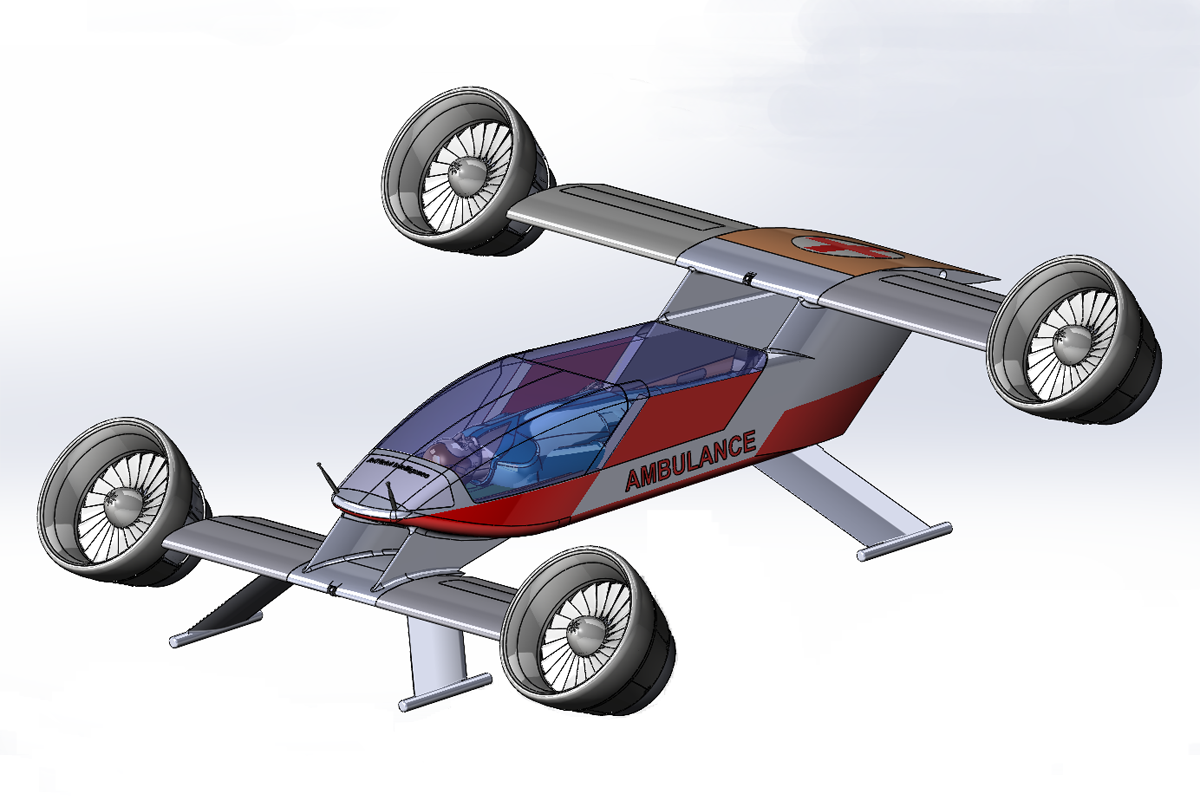
(Image credit: Gridiron Robotics)
Gridiron Flyer (concept design)
Gridiron Robotics (GoAERO team name)
Gridiron Robotics LLC
Chalfont, Pennsylvania, USA
www.gridironrobotics.com
Peter D'Amelio founded Gridiron Robotics in 2021 and is located in Chalfont, Pennsylvania, USA. The company's primary business is robotic logistics specializing in the automation of inbound and outbound package handling processes. D'Amelio, as a child, remembers his dad getting hit by a bus and it took an extremely long time for the ambulance to get to the hospital. Since then, he has always known there has to be a faster way for emergency crews to get crash victims to a hospital. When D'Amelio heard of the GoAERO competition, he realized logistics is the root of any effective emergency response crew and he entered the contest.
D'Amelio said, "Logistics is at the root of effective emergency response. At my company, it’s about analyzing data from our robots' sensors and identifying patterns using AI algorithms to optimize the robots' movements, maximize efficiency and minimizing errors. That's also the goal of our GoAERO flyer."
Team Gridiron Robotics entered the GoAERO competition with its emergency response eVTOL aircraft. Although the team was not selected as a Stage 1 or Stage 2 prize winner, the project demonstrated the team's approach to emergency response aircraft design.
Gridiron Flyer emergency rescue passenger eVTOL aircraft (concept design)
The Gridiron Flyer is an autonomous emergency rescue passenger eVTOL aircraft. The eVTOL aircraft has the capability to carry passengers, rescue crew and medical suppliers to unknown complex dangerous environments, that helicopters cannot fly into, to deliver medical supplies to and rescue victims of natural disasters. The aircraft can be transported by a highway legal trailer or large pickup truck and is then able to fly to and back from a rescue zone.
The aircraft has a canopy over the patient cabin allowing rescue crews to see inside the aircraft and the canopy also protects the victim during flight from gusty winds and debris. The rescue victim lays on a stretcher in the supine position during flight. The aircraft has four tilting electric ducted fans (EDFs), four electric motors and is powered by battery packs. The EDFs are located at the ends of the tandem wings. The wings can tilt up when towed or stowed. The expected maximum payload weight of the aircraft is ~250 lb (~113 kg). The fuselage is made from carbon fiber composite to give the aircraft a high strength to low weight ratio. The vehicle has fixed quadricycle skid landing gear.
D'Amelio noted that his GoAERO team has taken advantage of the expertise that has been learned with his logistics company. For example, he notes that Gridiron’s advanced robotic systems, specifically engineered for package handling tasks, are capable of picking, sorting and transporting packages with remarkable speed and precision. In addition, their robots, equipped with sophisticated sensors and computer vision technology, can identify and track packages in real-time, ensuring each package is handled with optimal care and efficiency.
About the GoAERO Prize Competition
The GoAERO Prize, sponsored by Boeing, is a three year competition (2024-2027) offering over $2 million USD in prizes that challenges engineers worldwide to create portable, versatile and autonomy-enabled Emergency Response Aircraft that address not only everyday medical emergencies but also to be used in natural disasters, humanitarian emergencies and climate crises worldwide. Each team designs and builds autonomous Emergency Response aircraft capable of delivering a first responder, medical equipment and supplies and ultimately evacuating victims in need to a rescue ambulance or hospital.
More than 150 teams from around the globe are competing for the GoAero prizes. The GoFly and GoAERO prizes were developed by Boeing, NASA and other organizations to help the nascent advanced air mobility (AAM) industry move forward.
Specifications:
- Aircraft type: Emergency rescue passenger eVTOL concept design
- Piloting: Autonomous
- Capacity: 1 survivor (of a natural disaster or accident)
- Cruise speed:
- Range: 1.6 km (9.9 m) (GoAERO mission requirement)
- Flight time: 30 minutes (GoAERO mission requirement)
- Maximum payload weight: ~250 lb (~113 kg)
- Propellers: 4 tilting electric ducted fans (EDFs)
- Electric motors: 4 electric motors
- Power source: Batteries
- Fuselage: Carbon fiber composite
- Window: Canopy over cockpit
- Wings: Tandem wings
- Landing gear: Fixed quadricycle skid landing gear
- Safety features: Distributed Electric Propulsion (DEP) uses multiple propellers or electric ducted fans, each powered by electric motors, to increase safety through redundancy. If one or more components fail, the remaining ones can still ensure a safe landing. There are also redundancies of critical components in the sub-systems of the aircraft providing safety through redundancy. Having multiple redundant systems on any aircraft decreases having any single point of failure.
Company Insights:
- Gridiron Robotics Crunchbase
- Gridiron Robotics Pitchbook
- Gridiron Robotics Tracxn
Resources:
- Gridiron Robotics website
- Gridiron Robotics LinkedIn
- Article: Meet the Teams: Team Gridiron Robotics, GoAERO, Dec. 20, 2024

Recent Pages
- aeroG Aviation AG-8 (concept design)
- NASA Tiltwing-Two (illustration)
- CoolFly Urban 4 (concept design)
- CoolFly Standing Flight Platform (prototype)
- CoolFly Urban 3 (prototype)
- CoolFly Urban 2 (concept design)
- CoolFly Urban (production model)
- CoolFly Dream ST (production model)
- CoolFly Dream Pro (production model)
- CoolFly Dream (prototype)