Auburn University VT-04 Hexa-Hauler (concept design)
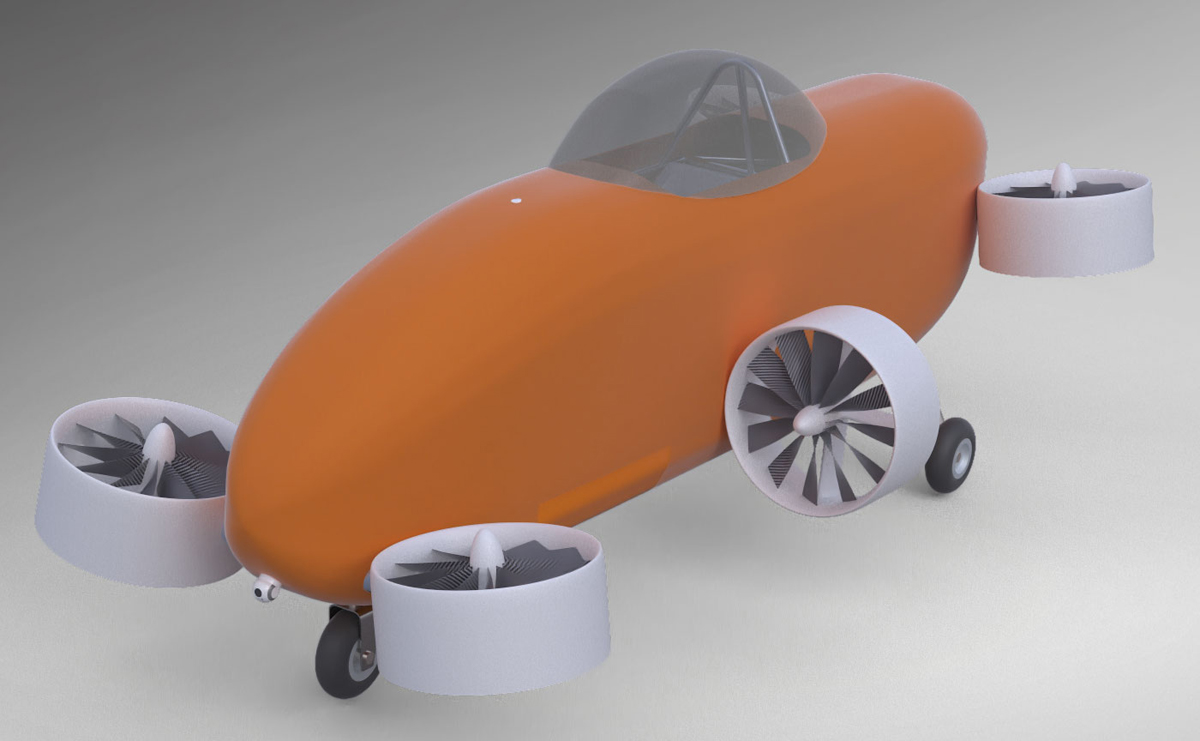
(Image credit: Vehicle Systems, Dynamics and Design Laboratory)
VT-04 Hexa-Hauler (concept design)
Vehicle Systems, Dynamics and Design Laboratory
Aerospace Engineering
Auburn University
Auburn, Alabama, USA
www.vsddl.com
Founded in August 2018 by Dr. Imon Chakraborty, the Vehicle Systems, Dynamics and Design Laboratory is a research lab that focuses on aircraft systems, dynamics, control, flight simulation and incorporating these aspects into aircraft sizing and design. A flight vehicle, whether novel or conventional, is a central theme of the lab. The research team, consisting of Dr. Chakraborty, PhD seeking graduate students as well as undergraduate researchers, has designed multiple electric vertical takeoff and landing (eVTOL) and hybrid-electric VTOL concept designs for advanced air mobility (AAM).
Since the lab was founded, the research facility has received more than $1.7 million (USD) in externally funded research, including funding from Federal Aviation Administration (FAA), NASA and the United States Air Force (USAF) and is also collaborating with multiple industry partners.
The team won the GoAERO Stage 1 and Stage 2 award in 2025 and was one of 14 NASA University Innovation Award winners. The team's efforts will also help the nascent advance air mobility (AAM) industry to gain traction. The GoAero team lead is Imon Chakraborty, Ph.D. with team members, Cole McCormick, Stefanus Putra, Bikash Kunwar and Rajan Bhandari.
VT-04 Hexa-Hauler piloted emergency response eVTOL (concept design) aircraft
The VT-04 Hexa-Hauler is an piloted or remotely piloted emergency response passenger eVTOL aircraft. The aircraft has been designed to operate in unknown complex disaster environments and still meet FAA requirements. The cockpit has a canopy over the cockpit providing excellent views.
The aircraft has six ducted fans, six electric motors and is powered by battery packs. The forward and aft ducted fans are stationary in VTOL mode. The middle row of ducted fans tilt for forward and aft propulsion. Two banks of battery packs are placed in the front and rear of the vehicle. The battery packs do not need to be removed when charging.
The estimated range is 1.6 km (9.9 m), has a projected flight time of 30 minutes and has calculated maximum altitude 15 m (49 ft). The foreseen minimum payload weight is 125 lb (57 kg) and can possibly have a maximum payload weight of 320 lb (145 kg). The payload is stored in a compartment underneath the vehicle with doors on the left and right side of the fuselage, as well as an aft hatch. The aircraft has been designed to carry larger items using a strong line and carried under the aircraft. The fuselage is made from carbon fiber composite to give the aircraft a high strength to low weight ratio. The aircraft has fixed tricycle wheeled landing gear.
The team designed the VT-04 Hexa-Hauler for Simplified Vehicle Operations (SVO), allowing the aircraft to be operated autonomously and semi-autonomously with minimal training and without requiring highly trained, experienced, and often hard-to-find professional pilots. It has also been designed to be deployed and operated with minimal ground support infrastructure. The aircraft is intended to be transported using only a standard pickup truck and road legal trailer, allowing it to be rapidly repositioned to support disaster relief operations. Once on-site, it can be unloaded and made flight-ready by a crew of three within a matter of minutes.
About the GoAERO Prize Competition
The GoAERO Prize, sponsored by Boeing, is a three year competition (2024-2027) offering over $2 million USD in prizes that challenges engineers worldwide to create portable, versatile and autonomy-enabled Emergency Response Aircraft that address not only everyday medical emergencies but also to be used in natural disasters, humanitarian emergencies and climate crises worldwide. Each team designs and builds autonomous Emergency Response aircraft capable of delivering a first responder, medical equipment and supplies and ultimately evacuating victims in need to a rescue ambulance or hospital.
More than 150 teams from around the globe are competing for the GoAero prizes. The GoFly and GoAERO prizes were developed by Boeing and other organizations to help the nascent advanced air mobility (AAM) industry move forward.
Specifications:
- Aircraft type: Emergency response passenger eVTOL (concept design) aircraft
- Piloting: Piloted or remotely piloted
- Capacity: A single-occupant aircraft that has cargo compartments for medical and other supplies
- Cruise speed: Unknown
- Range: 1.6 km (9.9 m) (GoAero mission requirement)
- Flight time: 30 minutes (GoAero mission requirement)
- Maximum altitude: Service ceiling 15 m (49 ft) (GoAero mission requirement)
- Maximum payload weight: Minimum 125 lb (57 kg) to a maximum 320 lb (145 kg) payload weight. (GoAero mission requirement)
- Propellers: 6 ducted fans (central fans can be tilted forward and aft)
- Electric motors: 6 electric motors
- Power source: Batteries
- Fuselage: Carbon fiber composite
- Window: Canopy over cockpit
- Landing gear: Fixed tricycle wheeled landing gear
- Safety features: Distributed Electric Propulsion (DEP) uses multiple propellers or electric ducted fans, each powered by electric motors, to increase safety through redundancy. If one or more components fail, the remaining ones can still ensure a safe landing. There are also redundancies of critical components in the sub-systems of the aircraft providing safety through redundancy. Having multiple redundant systems on any aircraft decreases having any single point of failure.
Related Aircraft:
- Auburn University Albatross (concept design)
- Auburn University Hexa-Chakra Personal Air Vehicle (concept design)
- Auburn University LPC-01 Pushpak (concept design)
- Auburn University LPC-02 DUeVTOL (concept design)
- Auburn University LPC-03 Phoenix (concept design)
- Auburn University TW-01 Minokawa (concept design)
- Auburn University TW-02 Pangolin (concept design)
- Auburn University VT-02 Sevak (concept design)
Company Insights:
Resources:
- Vehicle Systems, Dynamics and Design Laboratory, Auburn University website
- Vehicle Systems, Dynamics and Design Laboratory (eVTOL aircraft list), Auburn University website
- Vehicle Systems, Dynamics and Design Laboratory, Auburn University Facebook
- Vehicle Systems, Dynamics and Design Laboratory, Auburn University Twitter
- Vehicle Systems, Dynamics and Design Laboratory, Auburn University YouTube Channel
- Imon Chakraborty LinkedIn
- Auburn University website
- Article: Stage 1 Winners, GoAero, Feb. 2025
- Article: Vehicle Systems, Dynamics and Design Laboratory, GoAero, Feb. 2025
- Article: GoAERO Announces Eleven Stage 1 Winners, Aero News Network, Feb. 16, 2025
- Article: GoAERO Global Emergency Response Flyer Competition Announces $500,000 of Awards to Innovators Worldwide with Support from Boeing, NASA, RTX, and Honeywell, GoAero, Feb. 18, 2025
- Article: GoAERO Awards $500,000 to Stage 1 Teams, Vertiflite Magazine, Mar/Apr 2025
- Article: Meet the Teams: VSDDL of Auburn University, GoAero, Apr. 16, 2025
- Article: GoAERO Competition Promotes Creation of Automatic Lifesavers, Flying Magazine, Nov. 17, 2025
- Article: Stage 2 Winners, GoAero, Dec. 2025
- Article: Building the Future: GoAERO Announces Stage 2 Prototype Winners, GoAero, Dec. 3, 2025
- Article: GoAERO Global Emergency Response Flyer Competition Announces 8 Stage 2 Prototype Winning Teams, GoAero, Dec. 3, 2025
- Article: GoAERO Announces Stage 2 Prototype Winning Teams, Inspiring Creation of Emergency Response Flyers, eVTOL Insights, Dec. 4, 2025
- Article: First responders: Meet the self-flying aircraft built to take rescue aviation beyond helicopters, Aerospace Global News, Dec. 15, 2025

Recent Pages
- SMD Shenzhen Smart Drone UAV Bullet (production model)
- DreamFly Aerotech DF3000 Youlong (prototype)
- aeroG Aviation AG-8 (concept design)
- NASA Tiltwing-Two (illustration)
- CoolFly Urban 4 (concept design)
- CoolFly Standing Flight Platform (prototype)
- CoolFly Urban 3 (prototype)
- CoolFly Urban 2 (concept design)
- CoolFly Urban (production model)
- CoolFly Dream ST (production model)