ERC System Charlie C700 (production model)
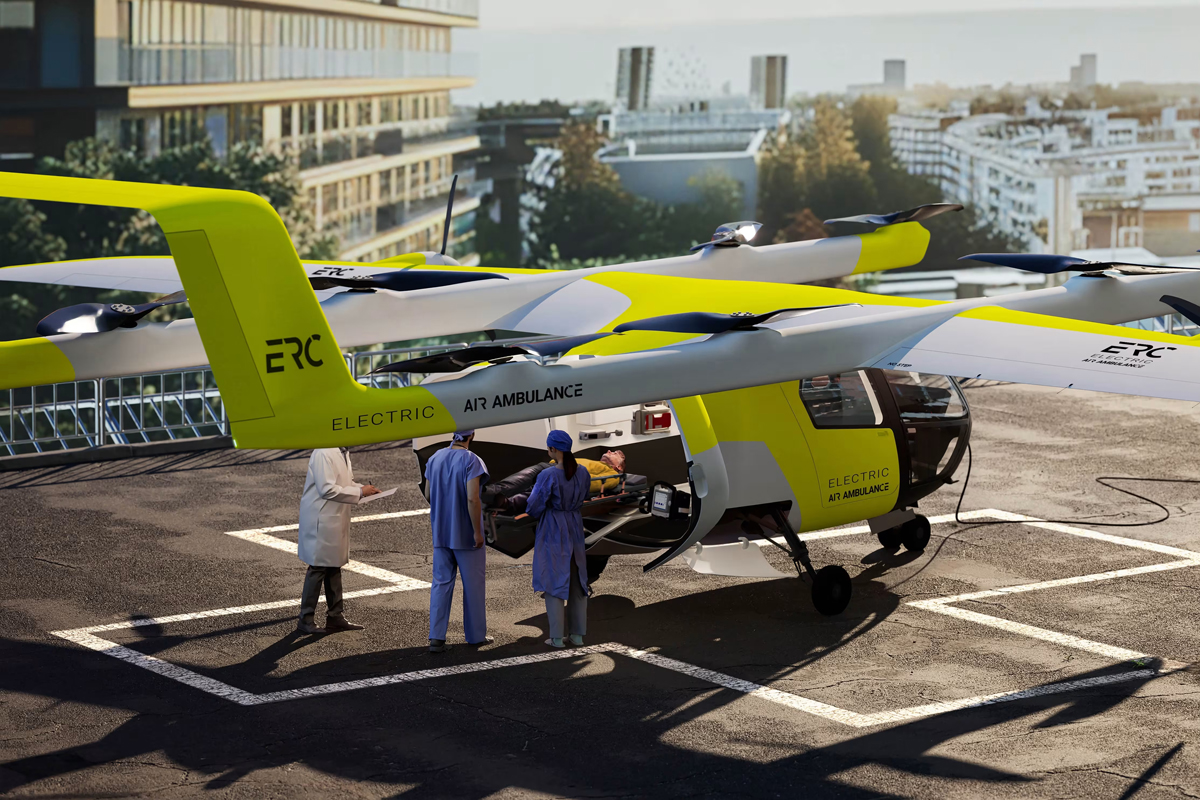
(Image credit: ERC System)
Charlie C700 (production model)
ERC System GmbH
Ottobrunn, Bayern, Germany
www.erc-system.com
Founded in 2020, ERC System GmbH is based in Ottobrunn, Germany. The company is in the business of designing and manufacturing long-range passenger hybrid-electric VTOL aircraft and long-range heavy-lift hybrid-electric VTOL drones. On July 3, 2024, the company came out of stealth mode. The company was dedicated from day one to make full-scale, flight-proven and mission-led from day one. The company has secured seed funding from IABG, a leading European technology company in the aerospace sector with core competencies in analysis, simulation and testing.
Prof. Dr.-Ing. Florian Holzapfel of the Technische Universität München provides ongoing research and development guidance and academic rigour. DRF Luftrettung, a leading German Helicopter Emergency Medical Services (HEMS) operators, joined the company as an operational partner, bringing real-world mission requirements directly into the development process.
Charlie model
From 2024, the findings from ERC’s Echo and Romeo and the current requirements from the medical field are incorporated into the development of the first marketable passenger eVTOL, Charlie. The development and predictable approval as well as the commercial launch of Charlie by 2031 (predicted in 2026) is only possible thanks to the product-related preliminary developments.
Benefits of eVTOL aircraft to humanity
"eVTOLs are three times faster than ambulances and three times more cost-effective than helicopters," said Dr. David Löbl, CEO, ERC System in 2024. The company has reported that an analysis was completed for both the USA and Europe combined and there are approximately 82 million injured and severely ill individuals each year that need urgent medical transportation. More than fifty percent of EMS helicopter transportation in this market is non-emergency and non-crisis transportation needed for patients to be transferred between two medical facilities and this is the first priority for ERC System.
The company has also stated that a typical EMS helicopter costs in the range of €9-15 million EUR ($9.7-16.2 million USD) as of July 2024. ERC System's aircraft is expected to be about one-third of that cost range. In addition, eVTOL aircraft can take off much faster than a helicopter and are less complex, reducing maintenance and operating costs.
Charlie C700 passenger hybrid-electric VTOL (production model) aircraft
The Charlie C700 is a piloted long-range passenger hybrid-electric VTOL aircraft. The aircraft will carry between three to four people and their luggage. While the company has been creating an emergency medical service interior for the aircraft, the Charlie C700's interior will be reconfigurable for many types of air missions. Some examples include on-demand air taxi service, regularly scheduled air travel, personal air travel, corporate travel, government travel, air cargo and military use.
The cruise speed of the aircraft is estimated to be 250 km/h (155 mph) and has a predicted range of 800 km (497 m). The aircraft has nine propellers (one pusher propeller and eight VTOL-only propellers), nine electric motors and is powered by a hybrid-electric power source. The maximum payload weight has been calculated to be 500 kg (1,102 lb). The aircraft has one high main wing, two booms for the VTOL-only propellers and has a boom mounted inverted U-tail. The fuselage is made from carbon fiber composite to give the aircraft a high strength to low weight ratio. The aircraft has retractable tricycle wheeled landing gear.
June 2026
In June 2026, the company predicted serial production for the Carlie C700 aircraft will take place in 2031.
Specifications:
- Aircraft type: Passenger hybrid-electric VTOL (production model)
- Piloting: Pilot using fly-by-wire controls
- Capacity: 3 or 4 passengers
- Cruise speed: 250 km/h (155 mph)
- Range: 800 km (497 m)
- Range (all electric): 200 km (124 m)
- Maximum payload weight: 500+ kg (1,102+ lb)
- Propellers: 9 propellers (1 pusher propeller, 8 VTOL-only propellers)
- Electric motors: 9 electric motors
- Power source: Hybrid-electric power source
- Fuselage: Carbon fiber composite
- Windows: Panoramic wrap around windows allowing forward, left and right visibility for spectacular views with a solid roof above the passenger compartment
- Wings: 1 main high wing (2 high booms are parallel to the fuselage that the VTOL-only propellers are mounted on top of)
- Wing Span: 15.2 m
- Tail: 1 boom mounted inverted U tail
- Landing gear: Retractable tricycle wheeled landing gear
- Safety features: Distributed Electric Propulsion (DEP) uses multiple propellers or electric ducted fans, each powered by electric motors, to increase safety through redundancy. If one or more components fail, the remaining ones can still ensure a safe landing. There are also redundancies of critical components in the sub-systems of the aircraft providing safety through redundancy. Having multiple redundant systems on any aircraft decreases having any single point of failure. The propellers are stationary at all times, this increases safety by reducing complexity.
Related Aircraft:
- ERC System Charlie (concept design)
- ERC System Echo (technology demonstrator)
- ERC System Romeo (technology demonstrator)
- ERC System Victor U250 (production model)
- ERC System Victor U250-M (production model)
Company Insights:
Resources:
- ERC System website
- ERC System Instagram
- ERC System LinkedIn
- Article: German Start-up ERC Unveils Emergency Medical eVTOL Aircraft, Aviation International News Online, July 3, 2024
- Article: ERC unveils eVTOL “For Faster, More Affordable Medical Transport Solutions in Europe”, eVTOL Insights, July 5, 2024
- Article: Solving the time-cost dilemma of patient transportation—ERC-System eVTOL aircraft, Fifty Sky Shades, July 6, 2024
- Article: ERC launches eVTOL concept to provide faster and more affordable patient transport, Urban Air Mobility News, July 7, 2024
- Article: ERC System Co-founder and CEO discusses new eVTOL for emergency services, Aerotime Hub, July 11, 2024
- Article: ERC Emerges from Stealth, Vertiflight, September/October 2024
- Article: German Startup ERC System Tests eVTOL Prototype After Industry Setbacks, EVMAGZ, Feb. 16, 2026

Recent Pages
- SMD Shenzhen Smart Drone UAV Bullet (production model)
- DreamFly Aerotech DF3000 Youlong (prototype)
- aeroG Aviation AG-8 (concept design)
- NASA Tiltwing-Two (illustration)
- CoolFly Urban 4 (concept design)
- CoolFly Standing Flight Platform (prototype)
- CoolFly Urban 3 (prototype)
- CoolFly Urban 2 (concept design)
- CoolFly Urban (production model)
- CoolFly Dream ST (production model)