Honda Aircraft Company F1 (technology demonstrator)
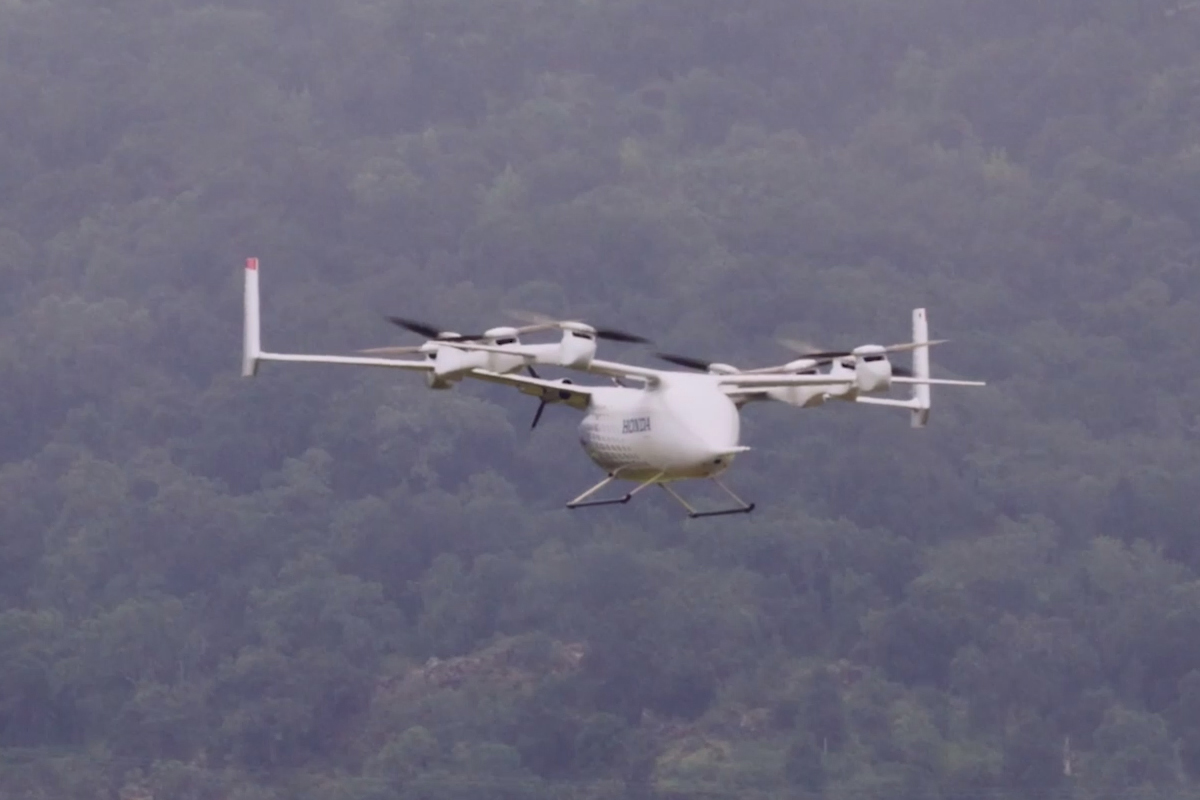
(Photo credit: Honda Aircraft Company)
F1 (technology demonstrator)
Honda Aircraft Company
Greensboro, North Carolina, USA
www.hondajet.com
Founded in 2006, Honda Aircraft Company is in the business of designing and manufacturing the HondaJet family of aircraft. Honda Aircraft introduced a number of innovations in general aviation jet aircraft, including an over-wing engine mount, natural laminar flow wings and a carbon fiber composite fuselage. Honda Aircraft was the first company to integrate Garmin glass cockpits for smaller jet aircraft. As of 2020, the company is now in the beginning stages of developing a passenger electric vertical takeoff and landing (eVTOL) aircraft for advanced air mobility (AAM).
The company started its eVTOL research and development program in stealth mode in 2020 and announced its program publicly in the fall of 2025. Honda started their eVTOL flight test program in 2024 and made three 1/3 subscale uncrewed eVTOL prototype aircraft. One prototype was used for wind tunnel testing and the other two prototypes were used for flight testing. The two flying prototypes have made over 400 flights as of July 2026. The wind tunnel 1/3 scale prototype was first shown to the public at the EAA AirVenture which took place in Oshkosh, Wisconsin, USA, July 20–26, 2026.
Honda has a history of making high-quality vehicles that are safe and reliable and has stated they plan to continue these high standards when developing its passenger eVTOL aircraft. Honda has also had a successful history of making successful hybrid turbine engines that generate electricity for the HondaJets small jet aircraft and the Honda Formula 1 race cars. The company plans to use both HondaJets jet aircraft and Honda Formula 1 race car technological expertise for their eVTOL aircraft. The company will use its knowledge with HondaJet interiors to create the best possible cabin interior for eVTOL passengers.
According to one news article published in June 2026, Honda has an advantage over its eVTOL competitors by being the only company in the world with FAA certificates for an aircraft airframe and jet engines. Since 2015, HondaJet has sold approximately 250 HA-420 HondaJet light business jets and with this track record, aviation professionals believe this will shorten the certification process for Honda's passenger eVTOL aircraft.
F1 full-scale uncrewed hybrid-electric VTOL (technology demonstrator)
The F1 is a full-scale remotely piloted uncrewed hybrid-electric VTOL (and eVTOL) technology demonstrator aircraft. The company intends to use a pilot for its first revenue flights and then transition to autonomous piloting. Honda is planning for the production model to start service in the United States which is why the company is working with the FAA for aircraft certification. The aircraft has a FAA tail number of N805HX.
The technology demonstrator has eight VTOL-only propellers mounted on two booms and has two pusher propellers. For the technology demonstrator's first flight in April 2026, the aircraft was powered with battery packs, only. Future test flights will use the company's proprietary gas turbine hybrid-electric engine for its power source. The maximum takeoff weight for the technology demonstrator is 7,000 lb (3,175.147 kg). The aircraft has tandem wings. The front wing is a forward swept wing and the rear wing is a standard swept wing (rear swept wing) with vertical stabilizers on the ends of the wings. The fuselage has no windows and has one access door on the port side of the aircraft. The fuselage is made from carbon fiber composite to give the aircraft a high strength to low weight ratio. The aircraft has fixed skid landing gear.
On April 1, 2026, the first F1 technology demonstrator test flight took place at Honda's development facility in San Luis Obispo, California, USA. The test flight lasted around 90 seconds. The aircraft's first flight was powered by an all-battery power source. Future flights are expected to be flown with a hybrid-electric power source. A Honda spokesperson stated the first flight milestone advances the company into the full-scale validation phase where the foundational technologies of the eVTOL aircraft are verified at real scale. The flight testing and system validation will take place primarily in the United States with the aim of obtaining FAA type certification sometime in the early 2030s.
Specifications:
- Aircraft type: Full-scale uncrewed eVTOL (technology demonstrator)
- Piloting: Remote piloting
- Capacity: No passengers.
- Cruise speed: Unknown
- Maximum takeoff weight: 7,000 lb (3,175.147 kg)
- Propellers: 10 propellers (8 VTOL-only propellers mounted on two booms, 2 pusher propellers located in the rear of the aircraft)
- Electric motors: 10 electric motors
- Power source: Gas turbine hybrid-electric power source or an all battery power source. Note: The first test flight was on April 1, 2026 used only battery packs.
- Fuselage: Carbon fiber composite
- Windows: No windows
- Access door: 1 access door on the port side of the fuselage
- Wings: Tandem swept wings. Front wing: Forward swept wing. Rear wing: Standard swept wing with a vertical stabilizer at the end of each wing tip.
- Landing gear: Fixed skid landing gear
- Safety features: Distributed Electric Propulsion (DEP) uses multiple propellers or electric ducted fans, each powered by electric motors, to increase safety through redundancy. If one or more components fail, the remaining ones can still ensure a safe landing. There are also redundancies of critical components in the sub-systems of the aircraft providing safety through redundancy. Having multiple redundant systems on any aircraft decreases having any single point of failure. The aircraft has no major moving surfaces or tilting parts when transitioning from vertical to forward flight and the reverse which increases safety by reducing complexity.
Related Aircraft:
- Honda eVTOL (concept design)
Company Insights:
Resources:
- HondaJet website
- Honda eVTOL web page
- HondaJet Facebook
- HondaJet Instagram
- HondaJet YouTube
- HondaJet X (Formerly Twitter)
- HondaJet LinkedIn
- Video: Honda eVTOL Achieves Key Milestone with Successful First Flight of Full-Scale Test Aircraft, Honda R&D, May 12, 2026
- Article: Honda completes maiden flight of full-scale eVTOL prototype, AeroTime, June 1, 2026
- Article: Honda Flies Full-Scale Hybrid eVTOL Demonstrator in U.S. — Dark Horse Enters Advanced Air Mobility Race, Aircraft Insider, June 3, 2026
- Article: Honda Aircraft Company Celebrates Two Decades of Aviation Innovation and Showcases the Future of Flight at EAA AirVenture 2026, Honda Aircraft Company, July 16, 2026
- Video: Vertical Lift: Inside Honda’s eVTOL Program, HondaJet, July 22, 2026

Recent Pages
- SMD Shenzhen Smart Drone UAV Bullet (production model)
- DreamFly Aerotech DF3000 Youlong (prototype)
- aeroG Aviation AG-8 (concept design)
- NASA Tiltwing-Two (illustration)
- CoolFly Urban 4 (concept design)
- CoolFly Standing Flight Platform (prototype)
- CoolFly Urban 3 (prototype)
- CoolFly Urban 2 (concept design)
- CoolFly Urban (production model)
- CoolFly Dream ST (production model)