Zuri Cargo (production model)
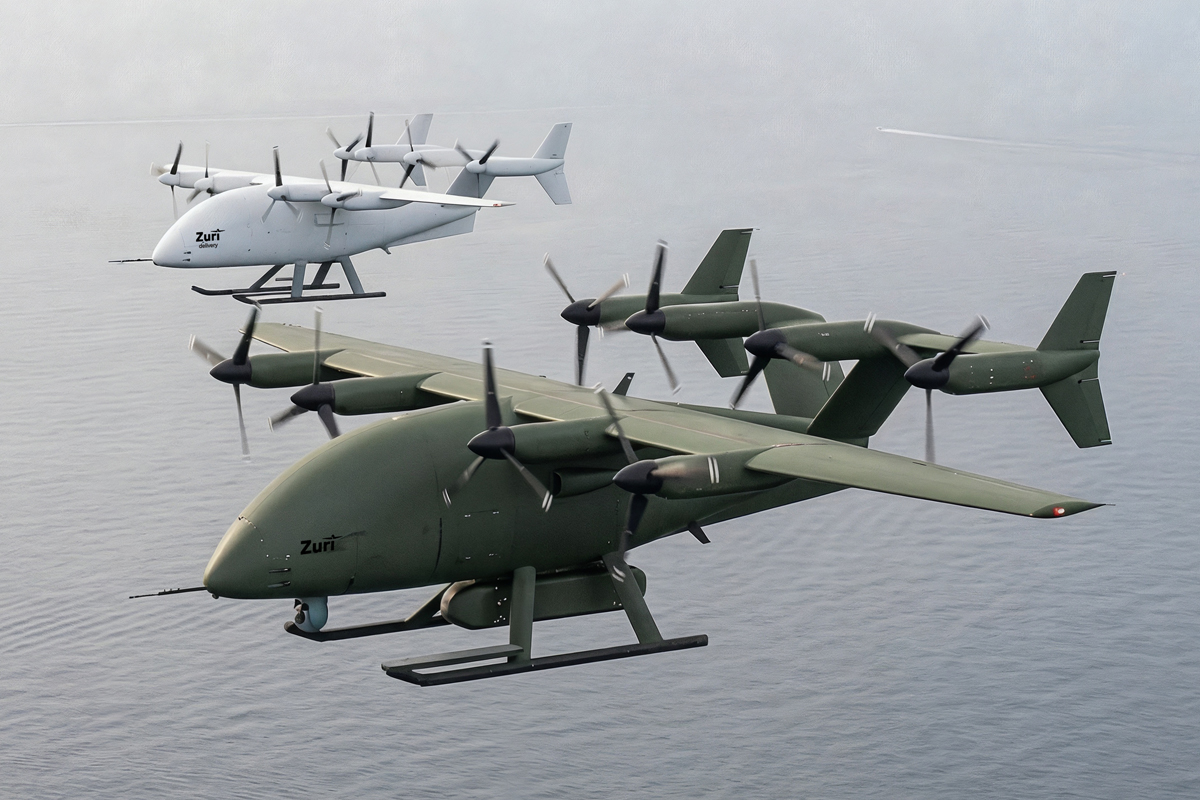
(Photo credit: Zuri)
Cargo (production model)
Zuri SE
Prague, Czech Republic
www.zuri.com
In 2017, Czech entrepreneur Michal Illich began his start-up company and conceptualized an aircraft with wings using hybrid-electric vertical takeoff and landing (VTOL) technology for advanced air mobility (AAM) between two cities (intercity flights). Illich has stated he started his company due to his frustration with the length of time it takes to fly between two fairly close cities using commercial jets.
Funding
As of October 2021, the company has raised over €2.4 million in financing. On December 16, 2024 Zuri reported they successfully completed a pre-series A funding round, initially targeting €1.5 million but significantly oversubscribed, raising a total of €4.4 million. Notable Investors were Pale Fire Capital (Jan Barta), Boris Renski (founder of FreedomFi and Mirantis), and Matej Turek’s 10X fund. As of August 2026, the company is currently seeking €6 million in its Series A round to support the development of its hybrid VTOL aircraft.
Company history
Illich reports he has founded several companies since 1999 and as of 2010, he is both an active investor in more than 20 companies and an entrepreneur in software and hardware. The company has received funding, is currently looking for more funding and is hiring employees.
September 2017 saw the first sketch of the of the hybrid-electric VTOL passenger aircraft. In May 2018, the first subscale prototype was made to validate their aircraft design. In August 2018, a larger subscale prototype was made and flown. May of 2019 saw the testing of components for their one-seater prototype. In September 2019, wind tunnel testing was performed on a subscale aircraft model.
In December 2020, ground testing took place with a large-scale technology demonstrator. On September 20, 2021, Zuri for the first time, revealed its hybrid-electric VTOL subscale technology demonstrator at an airport near Prague for the public. On Jan. 20, 2022, Zuri unveiled its new hybrid-electric VTOL production aircraft named the Zuri 2.0. The Zuri 2.0 has two versions, the Zuri 2.0 is a passenger VTOL aircraft and the Zuri 2.0 Cargo is an air cargo VTOL aircraft.
Cargo uncrewed long-range hybrid-electric VTOL drone (production model)
The Zuri Cargo is an uncrewed long-range hybrid-electric VTOL drone production model. The company expects the aircraft to be used for a variety of air cargo missions such as urban air cargo transportation, rural air cargo transportation, ship to shore air cargo transportation and more. The airframe is based on the Zuri's 2.0 airframe.
The cruise speed of the aircraft is 220 km/h (137 mph) and has a flight range between 679 km (421 m) to 883 km (549 m). The maximum payload weight of the drone is 145 kg (320 lb). The drone has eight tilt-props, eight electric motors and has a hybrid-electric power source. The air cargo drone has one high main wing with a V tail. The fuselage is made from carbon fiber composite to give the aircraft a high strength to low weight ratio. The cargo drone has fixed skid landing gear.
A pod can be attached underneath the aircraft that can carry sensors, a communications relay, air cargo and more. The external pod can be swapped out on the ground based on the customer's mission requirements.
Specifications:
- Aircraft type: Uncrewed air cargo hybrid-electric VTOL aircraft (production model)
- Piloting: Remotely piloted
- Capacity: Air cargo only. Has an optional under the fuselage external pod that can hold air cargo, electronics or other mission equipment.
- Cruise speed: 220 km/h (137 mph)
- Range (with maximum payload): 679 km (421 m) (Per Zuri's news article dated August 27, 2026.)
- Range (with maximum payload): 883 km (549 m) (Per Zuri's website.)
- Maximum payload weight: 145 kg (320 lb)
- Propellers: 8 tilt-props
- Electric motors: 8 electric motors
- Power source: Hybrid-electric power source
- Fuselage: Carbon fiber composite
- Wings: 1 main high wing
- Tail: 1 V tail
- Landing gear: Fixed skid landing gear
- Safety features: Distributed Electric Propulsion (DEP) uses multiple propellers or electric ducted fans, each powered by electric motors, to increase safety through redundancy. If one or more components fail, the remaining ones can still ensure a safe landing. There are also redundancies of critical components in the sub-systems of the aircraft providing safety through redundancy. Having multiple redundant systems on any aircraft decreases having any single point of failure.
Related Aircraft:
- Zuri (concept design)
- Zuri TD 1.0 (technology demonstrator)
- Zuri 2.0 (concept design)
Company Insights:
Resources:
- Zuri website
- Zuri Facebook
- Zuri X (formerly Twitter)
- Zuri YouTube Channel
- Zuri Instagram
- Zuri LinkedIn
- Article: Zuri Unveils Hybrid Cargo VTOL As First Commercial Product, Aviation Week, Aug. 27, 2026
- Article: Zuri unveils its first product: a hybrid uncrewed cargo VTOL, Zuri, Aug. 27, 2026
- Article: Czech startup Zuri unveils new unmanned cargo drone, eyes fresh capital, AeroTime, Aug. 28, 2026
- Article: Zuri launches uncrewed cargo VTOL, Avitrader, Aug. 31, 2026

Recent Pages
- aeroG Aviation AG-8 (concept design)
- NASA Tiltwing-Two (illustration)
- CoolFly Urban 4 (concept design)
- CoolFly Standing Flight Platform (prototype)
- CoolFly Urban 3 (prototype)
- CoolFly Urban 2 (concept design)
- CoolFly Urban (production model)
- CoolFly Dream ST (production model)
- CoolFly Dream Pro (production model)
- CoolFly Dream (prototype)