Nanyang Technological University Singapore NTU TD1 (technology demonstrator)
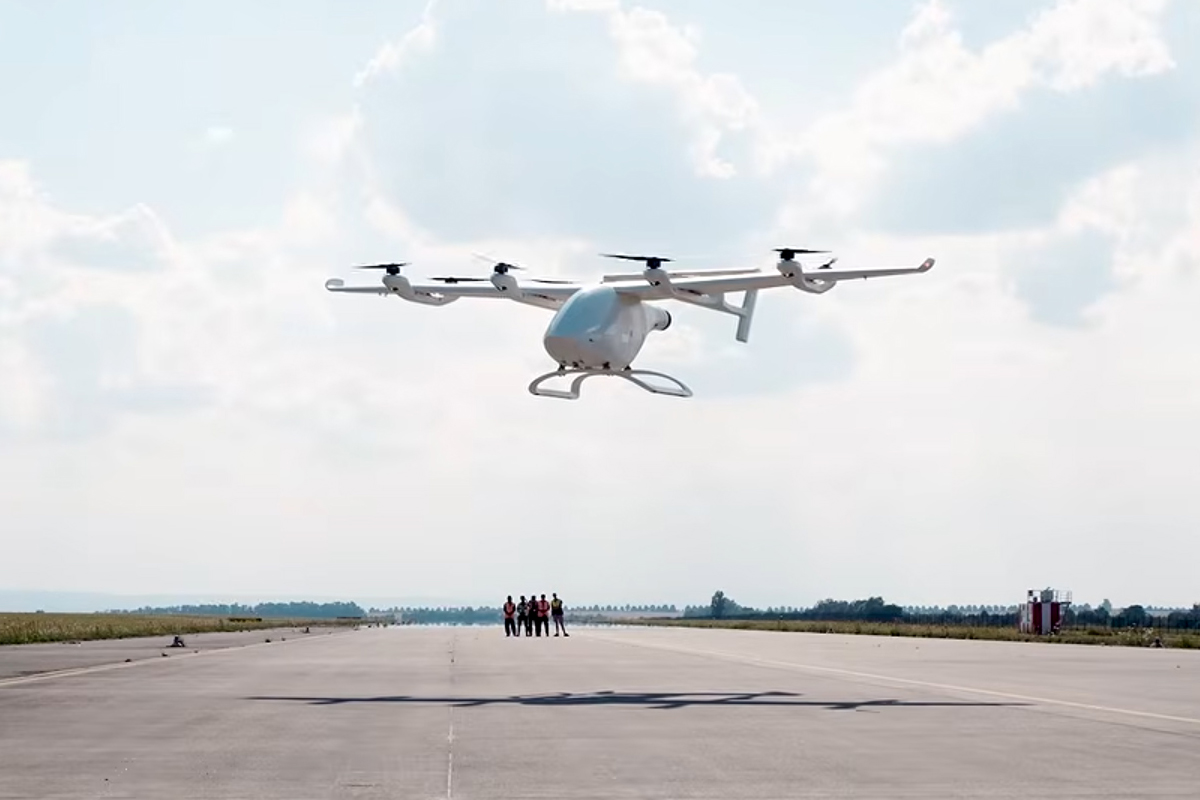
(Photo credit: Mechanical & Aerospace Engineering, Nanyang Technological University Singapore)
NTU TD1 (technology demonstrator)
School of Mechanical & Aerospace Engineering
Nanyang Technological University Singapore
Singapore, Singapore
www.ntu.edu.sg
Formed in 2021, Professor James Wang PhD is leading a research team at the School of Mechanical and Aerospace Engineering at the Nanyang Technological University Singapore to develop a clean-sheet passenger electric vertical takeoff and landing (eVTOL) for advanced air mobility (AAM). The team is proud to say their eVTOL aircraft has been designed, engineered and built in Singapore.
The team comprised of graduate students, worked for three years under secrecy using strict nondisclosure agreements (NDAs). Wang also partnered with multiple industry companies to help make their aircraft a success and these companies had to also sign NDAs.
Concerning his eVTOL team, Wang has stated that typical eVTOL programs are staffed by dozens of engineers with many years of experience; however, his team has about 30 graduates from the university. Wang has also said that working to develop a clean-sheet aircraft is a rare opportunity that many engineers will never experience. Some engineers can spend much of their careers developing just one component.
Wang formed a strong partnerships with international industry leaders including:
- Eaton Aerospace, Syensqo, Luminator and Diab, for aircraft systems and materials
- DLR and AVL for research and flight test support
- Embention, Volz, WingTeck, Bitec, BJO, and CEVA for flight control, electrical components, and logistics
- Admiralty and Flare Dynamics for manufacturing, integration and testing.
- Agency for Science, Technology and Research (A*STAR) and Republic Polytechnic for composite technology, talent development and translational expertise.
History
Wang has an Aeronautical Engineering and in Electrical Engineering degrees from M.I.T. and a Masters and PhD in Aerospace Engineering from the University of Maryland Advanced Rotorcraft Center. Around 1991, Wang's first job was at the Sikorsky Dynamics Group and worked there for 17 years. At Sikorsky, he worked on the Comanche, Black Hawk, Naval Hawk, S-92, S-76, CH-53 and the VH-3D helicopter programs and on variable diameter tilt rotor studies.
In 2007, Wang joined AgustaWestland (now Leonardo Helicopters), as vice president of research and development and reported directly to the CEO. He led his “Skunkworks” team in 2011 to design, build and fly the Project Zero eVTOL demonstrator in just six months. The 12 meter technology demonstrator shocked observers at the 2013 Paris Air Show.
He established three University Research Centers in Europe and one Think Tank in Japan. In 2015, Wang was promoted to Senior Vice President of Marketing, responsible for the global marketing strategy of all AgustaWestland helicopter products at Leonardo Helicopters. He served 7 years as a board member on the European Union's sponsored 2 billion euros CleanSky programs.
Wang has written over 40 technical papers and holds six patents. He has major international awards, including Fellow of the Royal Aeronautical Society, UTC Gold Mead Award, AHS Fellow, AHS Grover Bell Award, M.I.T. Luis de Florez Award, NASA Research Award, Italian National Innovation Grand Prize, and the Royal Aeronautical Society Gold Team Award.
When Wang moved to Singapore in 2019 and joined Nanyang Technological University Singapore, to establish an eVTOL Research and Innovation Center. His goal was to design and build an efficient and effective passenger eVTOL on-demand air taxi aircraft.
NTU TD1 remote controlled subscale eVTOL (technology demonstrator)
The NTU TD1 is a remote controlled one quarter subscale eVTOL technology demonstrator aircraft. In the future, the plan is to build a full-scale operational production model aircraft that can carry four passenger and one pilot, or alternatively air cargo and have a maximum payload weight of around 500 kg (1,102 lb).
The production prototype is expected to used for passenger or air cargo service with a maximum payload weight of 500 kg (1,102 lb). For passenger service the aircraft will hold one pilot, four passengers and their luggage.
The aircraft has eight VTOL-only propellers mounted on booms, has eight electric motors and is powered by battery packs. The aircraft has one high main wing and has one inverted U tail. The maximum payload weight of the technology demonstrator 200 kg (441 lb). The fuselage is made from carbon fiber composite to give the aircraft a high strength to low weight ratio. The aircraft has fixed skid landing gear.
Test fights
In October 2025, the first test flights were tethered hover flights at a restricted flight testing area in Kgranji, Singapore. According to the team, the stable hover of the aircraft was the first major validation milestone and confirmation that the aircraft’s core systems worked together as intended. It validated vertical lift, motor performance, electric power distribution, and flight control and stability.
Due to flight restrictions in Singapore, the team shipped the aircraft to Germany in two 40 foot intermodal containers to validate transition dynamics, stability across flight modes, control response and system interactions over longer durations and distances. The flight testing in Germany took place at the country's national aerospace research center called DLR (German Aerospace Center). The first untethered test flights took place in Germany in July 2026.
Prototype revealed to the public
The team revealed their aircraft on February 3 at the 2026 Singapore Airshow (February 3-8).
Future
The team foresees the production model aircraft being powered by hydrogen to extend the range of the aircraft. Wang noted that their aircraft is scalable and can be manufactured into various sizes. Wang stated they would need $975 million from investors (as of August 2026) to put the aircraft into production and it would take 10 years to start manufacturing. The team as received $25 million dollars from the Singapore government as of August 2026.
Specifications:
- Aircraft type: Remotely piloted subscale eVTOL (technology demonstrator)
- Piloting: Remotely piloted
- Capacity: No passengers
- Cruise speed: Unknown
- Maximum payload weight: 200 kg (441 lb)
- Propellers: 9 propellers. 8 VTOL-only propellers and 1 pusher propeller. The VTOL propellers are mounted on the top four booms.
- Electric motors: 9 electric motors
- Power source: Battery packs
- Fuselage: Carbon fiber composite
- Doors: Front nose can open upwards and there are doors on both the port and starboard sides of the aircraft. The side doors can be completely removed if necessary.
- Wings: 1 main high wing with winglets. Has an 8 m (26.3 feet) wingspan.
- Tail: 1 inverted U tail
- Landing gear: Fixed skid landing gear
- Safety features: Distributed Electric Propulsion (DEP) uses multiple propellers or electric ducted fans, each powered by electric motors, to increase safety through redundancy. If one or more components fail, the remaining ones can still ensure a safe landing. There are also redundancies of critical components in the sub-systems of the aircraft providing safety through redundancy. Having multiple redundant systems on any aircraft decreases having any single point of failure. The aircraft has no major moving surfaces or tilting parts when transitioning from vertical to forward flight and the reverse which increases safety by reducing complexity.
Company Insights:
Resources:
- Nanyang Technological University Singapore website
- Article: First homegrown electric vertical take-off and landing aircraft prototype debuts at Singapore Airshow 2026, Nanyang Technological University Singapore, Feb. 3, 2026
- Article: NTU unveils locally made aircraft prototype at Singapore Airshow, The Straights Times, Feb. 3, 2026
- Video: #NTUsg unveils Singapore's first locally designed and built electric aircraft, NTUsg, Feb. 3, 2026
- Article: Singapore’s secret eVTOL, built by new grads, Nanyang Technological University Singapore, Feb. 13, 2026
- Article: How we built Singapore's flying machine, Nanyang Technological University Singapore, Mar/Apr 2026.
- Article: Tech x Life, Nanyang Technological University Singapore, Mar/Apr 2026
- Video: NTU’s eVTOL aircraft, a bold new way to fly, NTU web, May 15, 2026
- Article: NTU Leads Singapore's First eVTOL Development with Pioneer James Wang, AcademicJobs,
- Article: NTU-built electric aircraft completes first phase of flight tests in Germany, The Straights Times, Aug. 25, 2026
- Video: First Singapore-made electric vertical take-off and landing (eVTOL) aircraft takes flight, The Straights Times, Aug. 25, 2026
- Video: NTU-built electric aircraft completes first phase of flight tests in Germany, CNA, Aug. 25, 2026
- Video: Singapore's first full-sized electric aircraft takes flight, NTUsg, Aug. 25, 2026

Recent Pages
- Alef Aeronautics Model Zero Ultralight (pre-production model)
- SMD Shenzhen Smart Drone UAV Bullet (production model)
- DreamFly Aerotech DF3000 Youlong (prototype)
- aeroG Aviation AG-8 (concept design)
- NASA Tiltwing-Two (illustration)
- CoolFly Urban 4 (concept design)
- CoolFly Standing Flight Platform (prototype)
- CoolFly Urban 3 (prototype)
- CoolFly Urban 2 (concept design)
- CoolFly Urban (production model)