LEO Flight LX-1 (technology demonstrator)
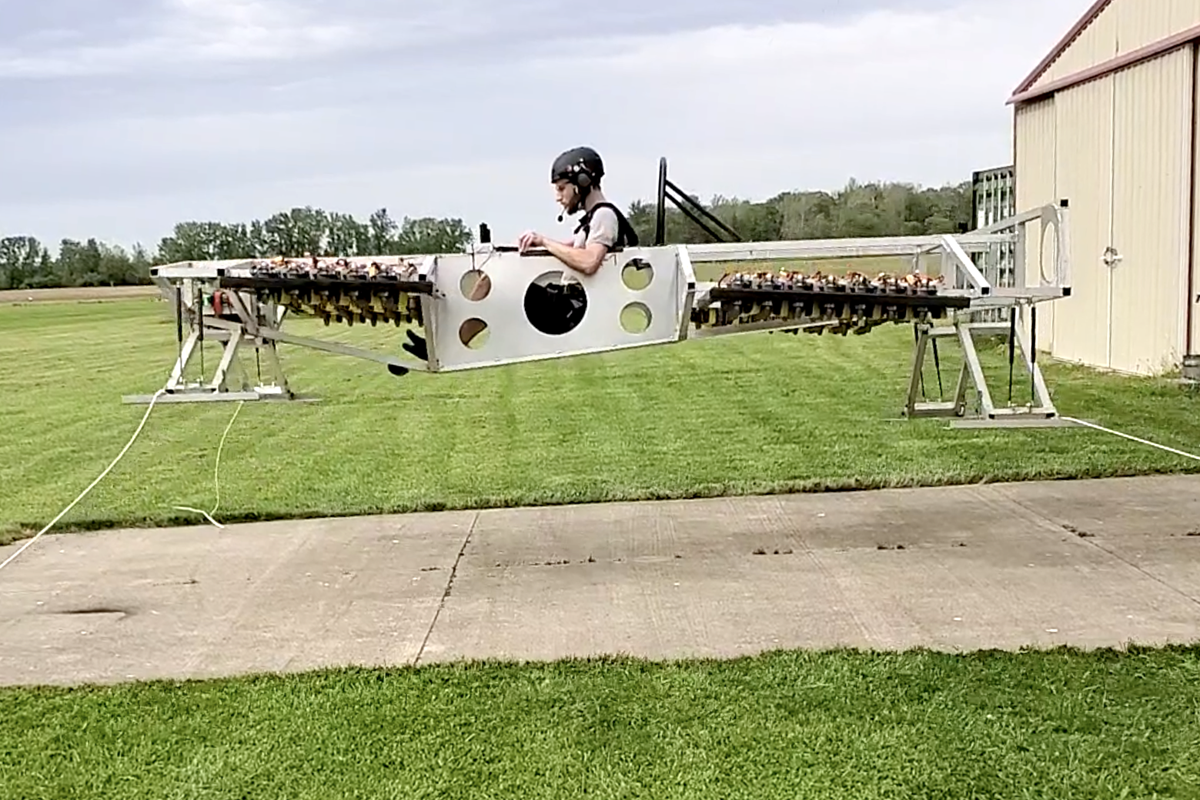
(Photo credit: LEO Flight Corporation)
LX-1 (technology demonstrator)
LEO Flight Corporation
Anderson, Indiana, USA
www.leoflight.com
Based in the USA, Pete Bitar and Carlos Salaff partnered together in the spring of 2021 and founded the company LEO Flight Corporation (formerly Urban eVTOL, LLC). The joint-venture is from Bitar's company Electric Jet Aircraft and Salaff's company SALAFF Automotive to design and manufacture electric vertical takeoff and landing (eVTOL) flying cars for advanced air mobility (AAM). The company is looking for investors.
Bitar is an avid VTOL and eVTOL inventor with over 14 patents to his name, has won multiple aerospace awards and has owned five companies throughout his career. His last two companies were AirBuoyant, LLC and Electric Jet Aircraft. Salaff is an automotive designer working with futuristic concept and production cars when at Mazda, including the Nagare, Furai, Mazda 3 and MX-5. He has won multiple design awards, has always had an interest in aerospace and outer space, and recently designed a Space Age inspired mobile office and lounge called the Pod Van.
LX-1 passenger eVTOL aircraft (technology demonstrator)
The LX-1 is a one passenger eVTOL technology demonstrator that was flown successfully by either remote control or a test pilot. The flights were very important, the company learned about stability, flight control, power to weight configurations and more. The first flight for the technology demonstrator took place in June 2022.
During flight, the aircraft was always tethered to the ground. The technology demonstrator had an open framed fuselage with an open cockpit. The cockpit seat had a roll bar, seat belts and a shoulder harness. The demonstrator had 72 electric ducted fans (EDFs), 72 electric motors and was powered by batteries. The aircraft used quadricycle shock-absorbing skid landing gear.
Specifications:
- Aircraft type: Passenger eVTOL aircraft (technology demonstrator)
- Piloting: 1 pilot or remote control
- Range: The technology demonstrator was always tethered to the ground
- Propellers: 72 EDFs (electric ducted fans)
- Electric motors: 72 electric motors
- Power source: Batteries
- Fuselage: Open framed fuselage
- Cockpit: Open cockpit with roll bar
- Landing gear: Quadricycle shock-absorber skid landing gear
- Safety features: Distributed Electric Propulsion (DEP) uses multiple propellers or electric ducted fans, each powered by electric motors, to increase safety through redundancy. If one or more components fail, the remaining ones can still ensure a safe landing. There are also redundancies of critical components in the sub-systems of the aircraft providing safety through redundancy. Having multiple redundant systems on any aircraft decreases having any single point of failure. The aircraft has no moving surfaces or tilting parts when transitioning from vertical to forward flight and the reverse which increases safety by reducing complexity.
Related Aircraft:
- LEO Flight JetBike (mockup)
- LEO Flight LEO Coupe (concept design)
- LEO Flight LX1-R (technology demonstrator)
- LEO Flight Lynx (defunct)
Company Insights:
- LEO Flight Wikipedia
Resources:

Recent Pages
- SMD Shenzhen Smart Drone UAV Bullet (production model)
- DreamFly Aerotech DF3000 Youlong (prototype)
- aeroG Aviation AG-8 (concept design)
- NASA Tiltwing-Two (illustration)
- CoolFly Urban 4 (concept design)
- CoolFly Standing Flight Platform (prototype)
- CoolFly Urban 3 (prototype)
- CoolFly Urban 2 (concept design)
- CoolFly Urban (production model)
- CoolFly Dream ST (production model)