LEVA Aerospace Guardian (concept design)
(Image credit: LEVA Aerospace)
Guardian (concept design)
LEVA Aerospace
Sunnyvale, California, USA
www.levaaerospace.com
Founded by Preston Wang, LEVA Aerospace is in the business of designing and manufacturing passenger electric vertical takeoff and landing (eVTOL) aircraft. The company is located in Sunnyvale, California, USA. LEVA Aerospace has participated in the GoAERO three year competition sponsored by Boeing. The team's goal for the competition is to design a portable autonomous emergency rescue eVTOL aircraft that can quickly find natural disaster victims and fly them to a hospital for immediate care. The aircraft's other mission parameter is to be able to fly into complex, low visibility weather and dangerous environments where helicopters can't fly. LEVA means lift in Latin.
Guardian autonomous passenger eVTOL aircraft (concept design)
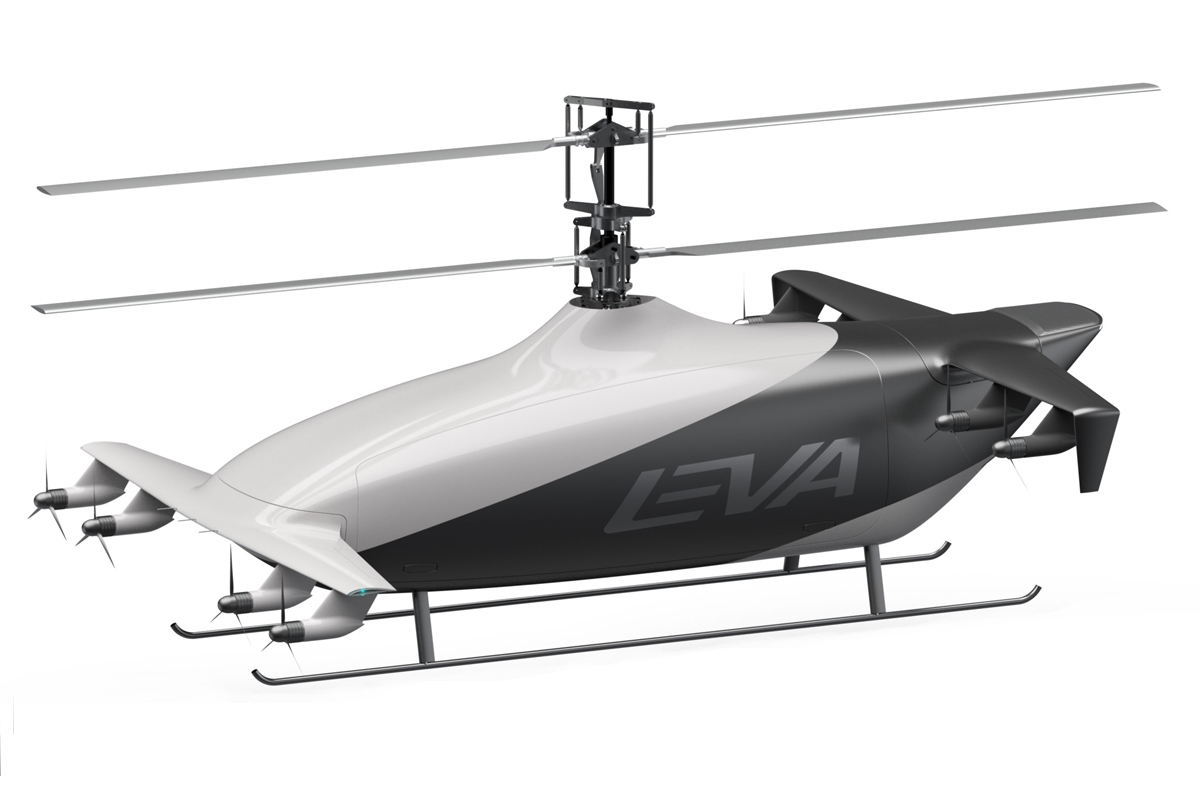
The Guardian is an autonomous passenger eVTOL compound helicopter. The stub wings should help with lift during cruise flight and allow the rotorblades to be slowed down. The GoAERO competition requires that the aircraft has to be small enough to be transported on a trailer or large pickup truck. The aircraft also has to be able to fly to and from the rescue zone. The team foresees their aircraft to be towed near a rescue zone and then fly the victim directly to a hospital.
The aircraft has coaxial rotorblades, has eight stationary propellers for forward flight and is powered by all-batteries or uses a hybrid-electric power source. The aircraft has either eight or nine electric motors. The aircraft has tandem stub wings where the eight forward flight propellers are located. The rear wing has downward winglets in addition to their propellers. The fuselage is made from carbon fiber composite to give the aircraft a high strength to low weight ratio. The aircraft has fixed skid landing gear.
About the GoAERO Prize Competition
The GoAERO Prize, sponsored by Boeing, is a three year competition (2024-2027) offering over $2 million USD in prizes that challenges engineers worldwide to create portable, versatile and autonomy-enabled Emergency Response Aircraft that address not only everyday medical emergencies but also to be used in natural disasters, humanitarian emergencies and climate crises worldwide. Each team designs and builds autonomous Emergency Response aircraft capable of delivering a first responder, medical equipment and supplies and ultimately evacuating victims in need to a rescue ambulance or hospital.
More than 150 teams from around the globe are competing for the GoAero prizes. The GoFly and GoAERO prizes were developed by Boeing and other organizations to help the nascent advanced air mobility (AAM) industry move forward.
Specifications:
- Aircraft type: Autonomous emergency rescue passenger eVTOL aircraft (concept design)
- Piloting: Autonomous
- Capacity: 1 passenger
- Cruise speed: Unknown
- Payload weight: 125 lb (57 kg) or more (A GoAERO requirement)
- Propellers: Coaxial rotorblades and 8 stationary propellers for forward flight
- Electric motors: 8 or 9 electric motors
- Power source: Uses all batteries or uses a hybrid-electric power source
- Fuselage: Carbon fiber composite
- Windows: Panoramic wrap around windows allowing forward, left and right visibility for spectacular views with a solid roof above the passenger compartment
- Window: Canopy over cockpit
- Wings: Tandem stub wings, the rear wing has downward winglets
- Landing gear: Fixed skid landing gear
- Safety features: Distributed Electric Propulsion (DEP) uses multiple propellers or electric ducted fans, each powered by electric motors, to increase safety through redundancy. If one or more components fail, the remaining ones can still ensure a safe landing. There are also redundancies of critical components in the sub-systems of the aircraft providing safety through redundancy. Having multiple redundant systems on any aircraft decreases having any single point of failure.
Related Aircraft:
- LEVA Aerospace Ambassador (concept design)
Resources:
- LEVA Aerospace website
- LEVA Aerospace LinkedIn
- Article: Meet the Teams: LEVA Aerospace, GoAERO, Aug. 19, 2026
- Article: GoAERO Competition Promotes Creation of Automatic Lifesavers, Flying Magazine, Nov. 17, 2025

Recent Pages
- aeroG Aviation AG-8 (concept design)
- NASA Skylark (concept design)
- CoolFly Urban 4 (concept design)
- CoolFly Standing Flight Platform (prototype)
- CoolFly Urban 3 (prototype)
- CoolFly Urban 2 (concept design)
- CoolFly Urban (production model)
- CoolFly Dream ST (production model)
- CoolFly Dream Pro (production model)
- CoolFly Dream (prototype)