MightyFly 2024 Cento, 3rd Gen eVTOL (prototype)
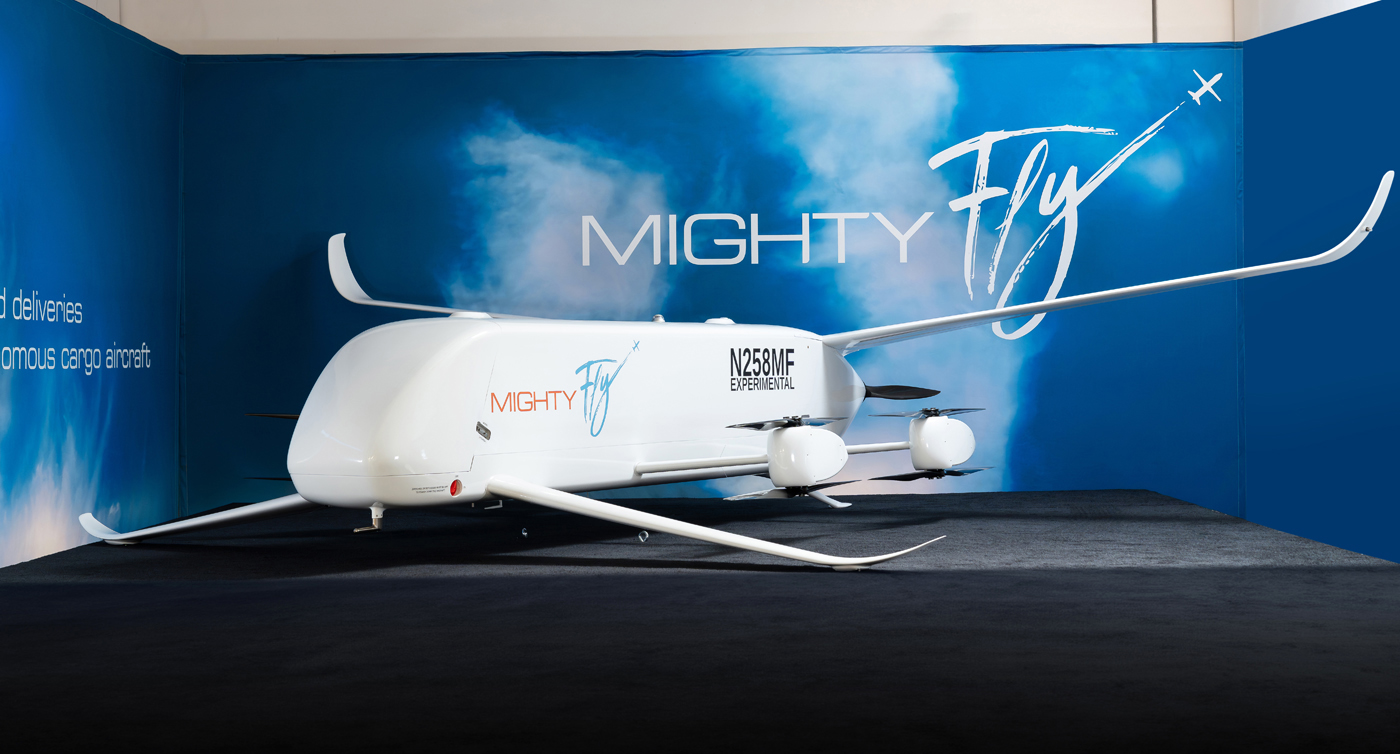
2024 Cento, 3rd Gen eVTOL (prototype)
MightyFly
San Francisco, California, USA
www.mightyfly.com
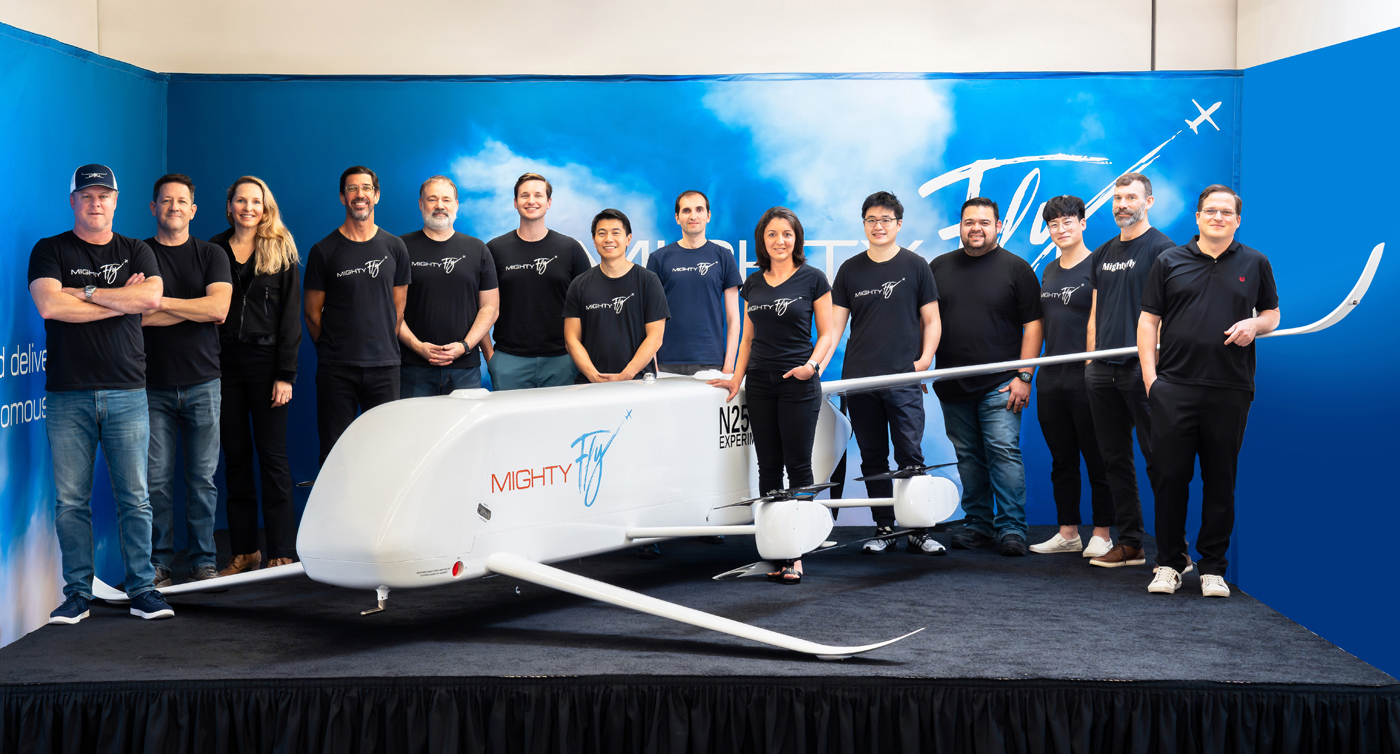
MightyFly was founded by CEO Manal Habib in 2019 and is based in San Francisco, California, USA. Habib previously developed the first robust commercial flight controller for small drones, when she realized a need for a larger autonomous aircraft with a greater cargo capacity. Habib is a private pilot and aerospace engineering graduate of the Massachusetts Institute of Technology (MIT) and Stanford University. The goal of the company is to enable point-to-point, same-day, expedited deliveries that are fast, affordable and carbon neutral. MightyFly’s team of experts in the aerospace industry are uniquely qualified to disrupt the logistics industry via large autonomous cargo aircraft. (Image credit: MightFly)
On April 20, 2021, MightyFly announced the development of their MF100 autonomous hybrid-electric vertical takeoff and landing (VTOL) air cargo prototype aircraft and that it had closed a $5.1 million USD seed funding round. Habib is the first female CEO of a hybrid-electric VTOL company that has raised funds of this level to date. The seedling funds will support the company's plans to scale its workforce and the production of its hybrid-electric VTOL cargo aircraft for advanced air mobility (AAM).
2024 Cento, 3rd Gen eVTOL autonomous hybrid-electric VTOL air cargo prototype drone
The 2024 Cento, 3rd Gen eVTOL is a third generation autonomous hybrid-electric VTOL heavy-lift air cargo prototype drone that has a payload capacity of 100 lb (45 kg), has an empty weight of 396 lb (180 kg) and has a maximum takeoff weight of 550 lb (249 kg). The aircraft can haul 212 UPS small packages and the cargo bay's dimensions are 72 L X 18.5 W X 19.5 H - inches (182 L X 47 W X 49 H - centimeters). Cento means one hundred in Italian and stands for the drone's maximum payload weight of 100 lb (45 kg).
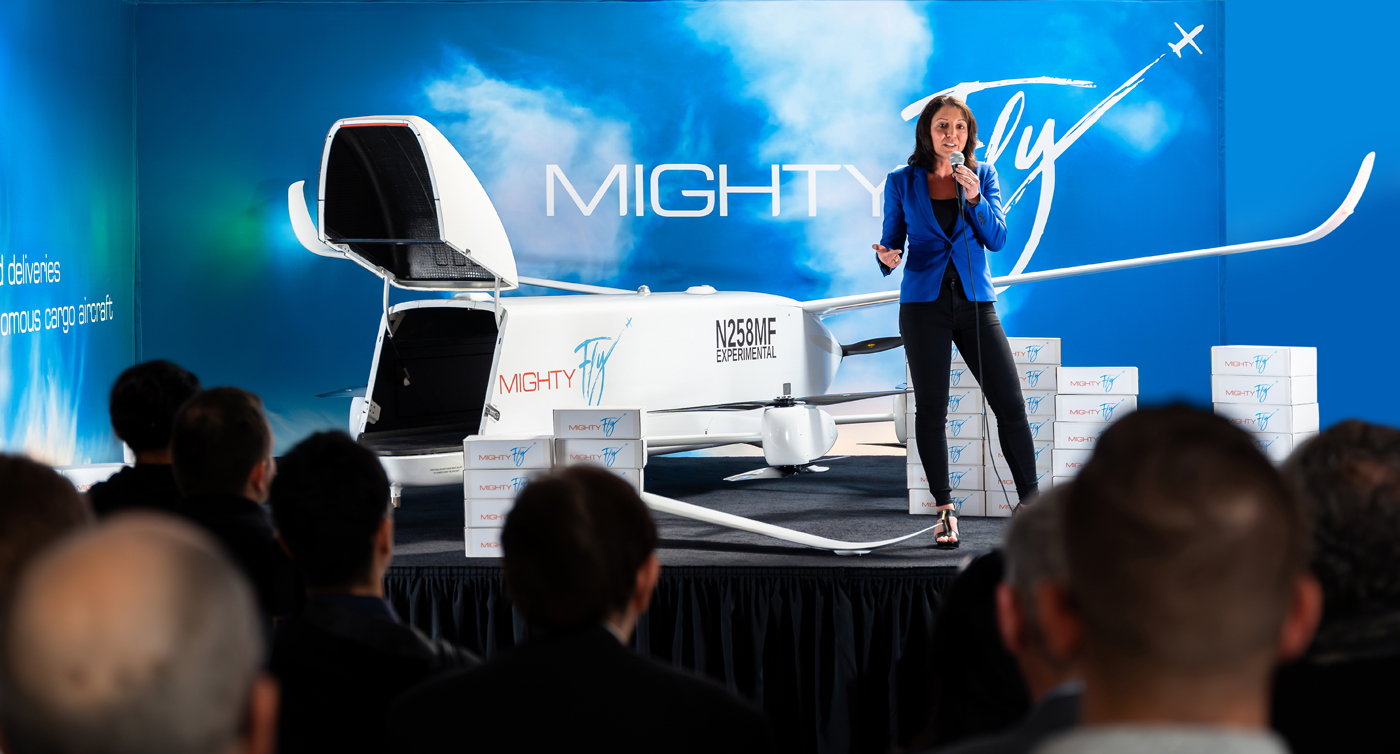
The drone has an automated load mastering system that will automatically open and close the cargo bay door, load and eject packages from the cargo bay, move and secure packages in the cargo bay using an internal positioning and locking system and then sense and perform a weight and balance of the cargo. These tasks are all completed autonomously reducing the work load for ground crew.
The cruise speed of the drone is 150 mph (240 km/h), has a range of 600 miles (966 km) and has a maximum flight time of four hours. The drone has a front canard wing with winglets and one rear high main wing with winglets. The aircraft has eight stationary VTOL propellers located on two booms parallel and in the center of the fuselage and has one pusher propeller for forward flight. The aircraft has nine electric motors and is powered by a hybrid-electric power source, including batteries. The fuselage and wings are made from carbon fiber composite for a high strength and low weight ratio.
The aircraft's landing gear consists of landing on the bottom of the front canard and one rear landing strut. Due to the drone having eight VTOL propellers, if several of the propellers stop working, the remaining propellers can land the drone safely. The aircraft requires the equivalent area of three parking spaces to land, making it easy to land in unprepared parking lots, loading dock areas, grassy areas, vertiports or airports.
The range of the aircraft would allow cargo to be delivered from San Francisco to San Diego (both cities are in California), for example, as well as deliveries from urban to rural areas. The drive from San Francisco to San Diego is eight and half hours or more, depending upon how many stops you make. Videos from the company show a rectangular fenced area where the aircraft could dock or on a specially made elevated loading dock landing pad.
Aircraft missions and test flights
The company points out that businesses such as logistics, manufacturers, medical facilities, the pharmaceutical industry, retailers, automotive industry, oil and gas industry, humanitarian relief, government defense and more, that need affordable and quick same-day air cargo services. The company has been making successful test flights since April 2021. The first generation flight testing started on April 2021, the second generation flight testing started in December 2022 and the third generation flight testing will start in February 2024. On May 30, 2023, the company was awarded a $150,000 grant from the Michigan Mobility Funding Platform to perform autonomous cargo delivery flight demonstrations in Michigan state (USA).
Future goals
The company aims to achieve FAA Part 135 Air Carrier and Operator Certification and airworthiness certifications in other markets such as Australia and Asia, providing logistics or cargo directly to the point of need, such as businesses in remote areas. The company foresees proof-of-concept delivery services starting in 2024 and, after that, serial production of their aircraft.
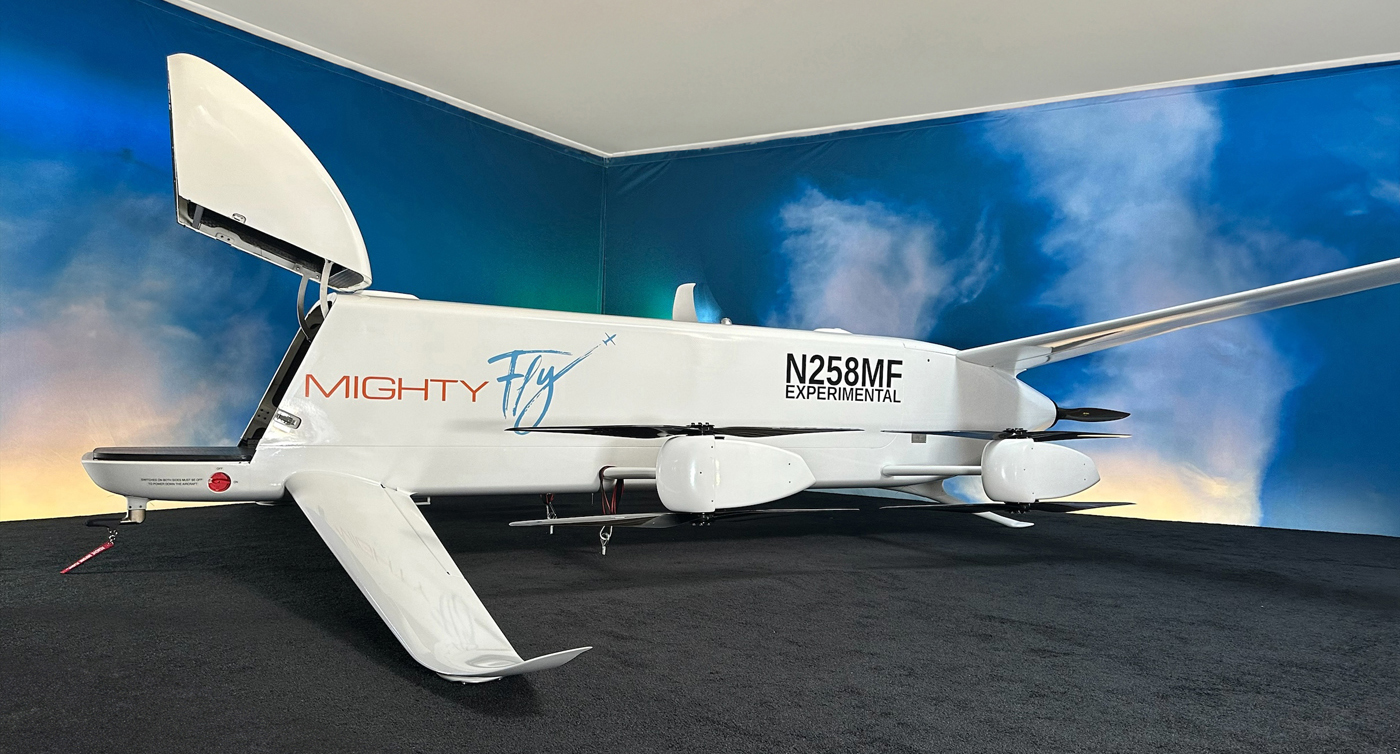
MightyFly 2024 Cento, 3rd Gen eVTOL prototype unveiling, with the cargo bay door open, on January 25, 2024 in San Leandro, California, USA.
Specifications:
- Aircraft type: Hybrid-electric VTOL cargo drone
- Piloting: Autonomous
- Capacity: Cargo only (212 small packages)
- Cargo bay: 72 L X 18.5 W X 19.5 H - in (182 L X 47 W X 49 H - cm)
- Cruise speed: 150 mph (240 km/h)
- Range: 600 miles (966 km)
- Flight time: 4 hours
- Empty weight: 396 lb (180 kg)
- Maximum payload: 100 lb (45 kg)
- Maximum takeoff weight: 550 lb (249 kg)
- Propellers: 8 VTOL propellers (on two booms parallel to the fuselage), 1 pusher propeller
- Electric Motors: 9 electric motors
- Power source: Hybrid-electric power source
- Fuselage: Carbon fiber composite
- Wings: 1 front canard wing with winglets and 1 rear high main wing with winglets
- Landing gear: Canard wing and rear landing strut
- Safety Features: Distributed Electric Propulsion (DEP), provides safety through redundancy for its passengers and/or cargo. DEP means having multiple propellers and motors on the aircraft so if one or more motors or propellers fail, the other working motors and propellers can safely land the aircraft.
Related aircraft:
- MightyFly MVP, 1st Gen eVTOL (prototype)
- MightyFly 2023 Cento, 2nd Gen eVTOL (prototype)
Company Insights:
Resources:
- MightyFly website
- MightyFly Facebook
- MightyFly Twitter
- MightyFly YouTube Channel
- MightyFly LinkedIn
- Video: MightyFly Autonomous Flight, MightyFly, Apr. 13, 2021
- Article: Autonomous Air Cargo Startup Set to Revolutionize Logistics, MightyFly, Apr. 20, 2021
- Article: MightFly cleared to start autonomous cargo drone services, Future Flight, Apr. 20, 2021
- Article: MightyFly raises $5.1 million for its hybrid-electric cargo drone, Vertical Magazine, Apr. 21, 2021
- Article: MightyFly’s Next-Generation Drones Have Sky-High Potential, 500, Apr. 27, 2021
- Article: MightyFly Reveals MF-100, Electric VTOL News, May 2, 2021
- Video: MightyFly, the future of logistics, testimonials, MightyFly, Oct. 5, 2022
- Article: MightyFly Starts Flight Testing Longer-range Autonomous eVTOL Freighter Aircraft, FutureFlight, Jan. 24, 2023
- Article: MightyFly Unveils Cento eVTOL, Electric VTOL News, Jan. 24, 2023
- Article: MightyFly's new autonomous cargo drone carries 100 lb for 600 miles, New Atlas, Jan. 24, 2023
- Video: MightyFly’s autonomous cargo aircraft generations, MightyFly, June 23, 2023
- Article: Michigan Braces for MightyFly Cento Autonomous Cargo Delivery Flights, Autoevolution, June 28, 2023
- Article: MightyFly wins Michigan Mobility Grant to perform autonomous eVTOL flight demos, Vertical Magazine, June 28, 2023
- Article: MightyFly Cento To Perform World's First Public Demonstration of Autonomous eVTOL Delivery Flight Next Year, Simple Flying, June 29, 2023
- Article: Aerial cargo delivery: The first use cases of eVTOL aircraft, Vertical Magazine, July 7, 2023
- Article: MightyFly Unveils its New 2024 Cento Aircraft, the Third Generation of the MF100 eVTOL, Featuring Autonomous Delivery Operations, Efficient Design and a Larger Cargo Bay., MightyFly, Jan. 26, 2024
- Article: MightyFly demonstrates autonomous flight and cargo operations for the U.S. Air Force, Vertical Magazine, June 27, 2025

Recent Pages
- DreamFly Aerotech DF3000 Youlong (prototype)
- aeroG Aviation AG-8 (concept design)
- NASA Tiltwing-Two (illustration)
- CoolFly Urban 4 (concept design)
- CoolFly Standing Flight Platform (prototype)
- CoolFly Urban 3 (prototype)
- CoolFly Urban 2 (concept design)
- CoolFly Urban (production model)
- CoolFly Dream ST (production model)
- CoolFly Dream Pro (production model)