

- 29 Jan 2021 12:31 PM
- 0
More Joby Patent Designs Revealed
By Kenneth I. Swartz
During the past 11 years, Joby Aviation (the tradename of Joby Aero, Inc.) has designed a wide range of eVTOL aircraft with different configurations, but some of these innovative designs are only coming to light now with recent patent applications.
In May 2020, Joby Aero filed a 44-page patent application for a “VTOL Aircraft Using Fixed Forward Canted Rotors to Simulate Rigid Wing Dynamics (pdf).” It was published by the US Patent and Trademark Office on Jan. 7, 2021, as Publication No. 2021/0001979.
Joby lists the inventors as Gregor Veble Mikic, JoeBen Bevirt and Alex Stoll, and the new application is related to earlier provisional patent applications submitted by Joby in 2016, 2017 and 2019. These three and others were responsible for dozens of prior Joby patents (see “Inside Joby’s Unicorn: Flight Tests and Patents Reveal New Details,” Vertiflite, Jan/Feb 2021).
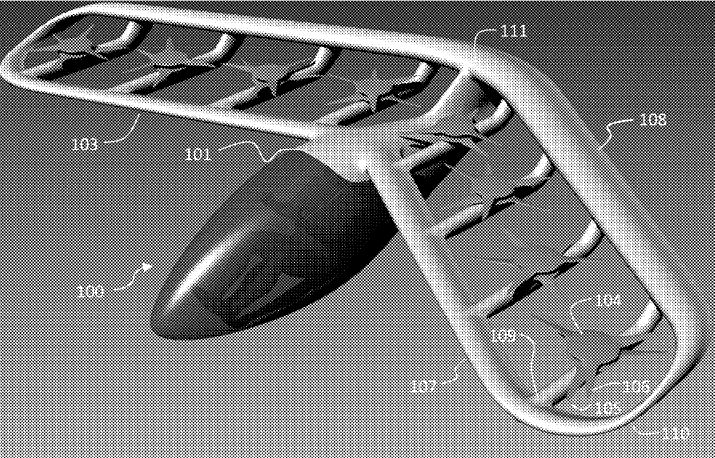
The application includes numerous drawings of several single-seat eVTOL aircraft that use fixed propellers (which the patent consistently refers to as “rotors”) for both VTOL and forward flight operations. Some of these propellers are positioned along the span of what Joby calls a “synthetic wing” or “pseudo-wing,” which in some illustrations have narrow front and rear airfoils that “may provide structural support as well as providing lift during forward flight.”
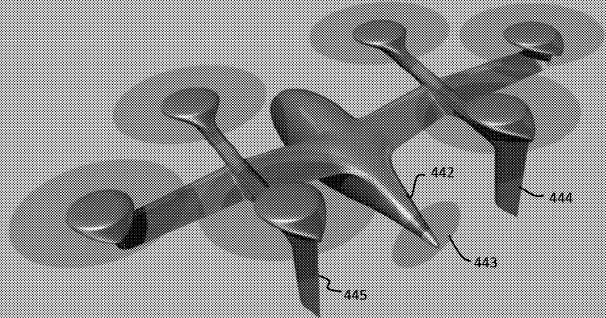
Other illustrations show that “the wing rotors [sic] are tilted forward and provide some forward propulsion during horizontal flight” with additional thrust provided by a tail-mounted pusher propeller.
What sets this application apart from other Joby patent filings is that the application contains a table with details on the aircraft, propellers, motor and performance specifications, with lift/drag (L/D) curves and other lift plots for several different propeller configurations to confirm high span efficiency.
The patent also describes the basic design optimization factors and challenges:
The efficiency of the aircraft (lift/drag ratio) during forward flight may be sought to be as high as feasible while balancing other aircraft parameters. For example, the ratio of the tip speed of the spinning wing rotors during forward flight to velocity of the aircraft is an important ratio to consider when designing for efficiency. Also, the percentage of lift provided by the wing rotors relative to the total lift (wings plus wing rotors) is an important ratio to consider when designing for efficiency. Also, the ratio of the power distribution between the wing rotors and the total power delivered to both the wing rotors and the traditional forward thrust propellers (a tail rotor, for example) is an important ratio to consider when designing for efficiency. The interplay between these ratios may be complex and does not lend itself to obvious optimization. An underlying design parameter is that the wing rotors provide sufficient vertical thrust during vertical take-off and landing to safely take-off and land the aircraft.
The patent also notes that another factor to be considered is the fraction of lift provided by the wing propellers relative to the total by both the wing and the wing propellers in forward flight.
The high degree of disclosure in the application (e.g. the table and L/D charts) suggests that Joby has achieved an important performance breakthrough and may even be open to licensing its “synthetic wing” technology.
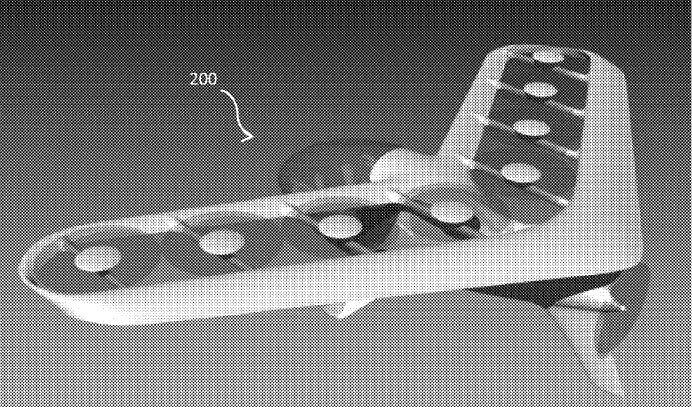
The single-seat eVTOL aircraft design described in the table has eight synthetic wing propellers contained within a 30° forward-swept wing and pusher-propeller mounted in the tail to achieve a 100-kt (185-km/h) cruise speed and a 50-nm (93-km) range using 32 kW total cruise power. This aircraft has a 1,100-lb (500-kg) maximum takeoff weight, a 220-lb (100-kg) payload, 330-lb (150-kg) battery, a 19-ft (5.8-m) wingspan, a 11.8-ft (3.6-m) length, 4.9-ft (1.5-m) height, a total wing area of 45.2-ft² (4.2-m²) — comprising front and rear airfoils — and an efficiency/drag ratio of 8 with the synthetic wing.
Each of the wing propellers has six blades, a propeller diameter of 2.6 ft (0.8 m), a disk loading of 25.4 lb/ft² (124 kg/m²), an inner propeller radius of 5.9 inches (0.15 m), a blade root chord of 2.4 inches (6 cm), a blade tip chord of 1.2 inches (3 cm), and an installed tilt angle in cruise of 10°. The tail-mounted pusher propeller has a diameter of 24.6 inches (60 cm).
And each of the eight electric motors for the propellers is rated at 50 kW peak power and 25 kW continuous power, but only 20 kW is utilized for hover (sea level) and 2 kW in cruise when the tail-mounted motor produces 16 kW turning the pusher propeller at 1,200 RPM.
One of the six blade propellers with a large hub illustrated in the application closely resembles a propeller used for bird strike tests in a presentation Joby delivered at the 2nd Annual VFS Electric VTOL Symposium in August 2015. This suggests that work on the synthetic wing occurred at the same time that Joby was developing its S2 and S4 tilt-propeller aircraft, which used a completely different propeller design.
Several charts in the application illustrate the lift-to-drag efficiency of different designs based on computational fluid dynamics (CFD) analysis.
Several different propeller configurations are also illustrated including stacked counterrotating propellers, longitudinally staggered propellers, vertically staggered propellers, overlapping propellers and wingtip propellers.
Most of the aircraft designs illustrated do not have a tail, ailerons, elevators or any other controllable surfaces. Instead, attitude control is provided by differentiating thrust and torque. In addition, “As the aircraft approaches cruise velocity, the wing rotors typically have their RPMs reduced, but they stay under power and provide a portion of the total lift of the aerial vehicle.”
It’s unusual for any of Joby’s patent applications to provide detailed aircraft specifications and performance data, yet alone L/D ratio charts. It may indicate that this technical approach and the aircraft concepts are no longer being pursued.
The patent suggests that Joby had designed an efficient lift-plus-cruise eVTOL design that has good lift-to-drag properties and consumes relatively low energy in cruise flight. However, the design may have been abandoned because of the technical challenges or because the concurrent Joby S4 air taxi development was so successful and deemed far superior.


Leave a Comment