Porsche Boeing Unnamed (III) (concept design)
Unnamed (III) (concept design)
Porsche and Boeing
Stuttgart, Baden-Württemberg, Germany
www.porsche.com
Porsche was founded on Apr. 25, 1931 by Ferdinand Porsche, Adolf Rosenberger and Anton Piëch in Stuttgart, Baden-Württemberg, Germany. The company is an automobile manufacturer specializing in luxury, high-performance sports cars, SUVs and sedans. It has been reported in 2022 that Porsche had €37.630 billion Euros in revenue and a total of 39,162 employees. For 2022 alone, their production output totaled 321,321 vehicles. On Oct. 10, 2019, Porsche and Boeing announced they signed a Memorandum of Understanding to explore the premium passenger electric vertical takeoff and landing (eVTOL) aircraft for the urban air mobility (UAM) market, now called advanced air mobility (AAM) market and the extension of urban traffic into airspace. (Image credit: Porsche)
In Sept. 2015, Porsche unveiled the Mission E all-electric concept sports car at the Frankfurt International Motor Show in Germany. Of note, the Mission E electric concept car can go from zero to 100 km/h (62 mph) in less than 3.5 seconds and inside, there is an intuitively operated by eye-tracking and gesture control system including using holograms. In Jun. 2018, the electric sports car got its official name, the Porsche Taycan. On Sept. 4, 2019 Porsche releases the production version with deliveries expected before the end of 2019. With that said, Porsche has the technical know-how to design and manufacture electric road vehicles. In March 2018, Porsche published a white paper on The Future of Vertical Mobility.
Porsche is looking to enhance its scope as a sports car manufacturer by becoming a leading brand for premium mobility. In the longer term, this could mean moving into the third dimension of travel. We are combining the strengths of two leading global companies to address a potential key market segment of the future. — Detlev von Platen, Member of the Executive Board for Sales and Marketing at Porsche AG, Porsche press release, Oct. 10, 2019
Three companies, Porsche, Boeing and Aurora Flight sciences, will be working together to design and create the eVTOL premium personal air vehicle. While the initial design which Porsche and Boeing created and revealed to the public on October 10, 2019, one can expect this design to change over time based on refined requirements by lead management, engineers, mission requirements and technological constraints.
As of Oct. 11, 2019, there is an international core team of 20 people located in St. Louis (USA), Stuttgart (Germany), and Lucerne (Switzerland) designing the eVTOL aircraft. The team consists of business development personnel, engineers and designers. This is the first time Porsche has explored Urban Air Mobility and discussions began in the summer of 2019.
A 2018 study by Porsche Consulting forecasts that the urban air mobility market will pick up speed after 2025. The study also indicates that urban air mobility solutions will transport passengers more quickly and efficiently than current conventional means of terrestrial transport, at a lower cost and with greater flexibility. –Porsche press release, Oct. 10, 2019
Unnamed (III) luxury passenger eVTOL concept design aircraft
The Unnamed (III) is an autonomous luxury two passenger eVTOL concept design aircraft that is very modern in design. The aircraft would have room for two passengers and their luggage. It is unknown if the aircraft could be switched over to manual piloting. (III is a designation we had to give the aircraft to distinguish it from at least two other Porsche eVTOL concept design aircraft. (III, or third eVTOL concept design, is a designation we had to give the aircraft to distinguish it from several other Porsche eVTOL concept design aircraft.)
While very few specifications were revealed for the concept design aircraft, one of the Porsche brochures estimated the cruise speed of passenger eVTOL aircraft would be approximately 200 km/h (~124 mph). There is no indication on the design where propellers or electric ducted fans (EDFs) would be on the aircraft. Most likely, the EDFs are housed in the wings with louvers that close over the EDFs while in forward flight. It is unknown how forward flight is achieved. We do know the aircraft would be powered by propellers (or electric ducted fans), use electric motors and are planned to be powered by easily removed fast-charging high-performance battery packs.
The aircraft has a canopy over the cockpit allowing forward, left and right visibility for spectacular views for the passengers. The aircraft has one main low blended wing body. At the tip of each wing, the wing is shaped downward and acts as a vertical stabilizer or winglet, that is also used as landing gear. The blended wing body is made from carbon fiber composite for a high strength and low weight ratio.
Working prototype targeted for 2020
Porsche has an ambitious plan to fly a working prototype in 2020. Very few details have been released about their eVTOL aircraft except that the personal air vehicle is currently planned to be 100% electric, will carry two passengers, will be a premium priced personal aircraft, will be well styled and will be an autonomous aircraft but will able to be flown manually if any passenger has the proper training to fly an aircraft.
Porsche patents
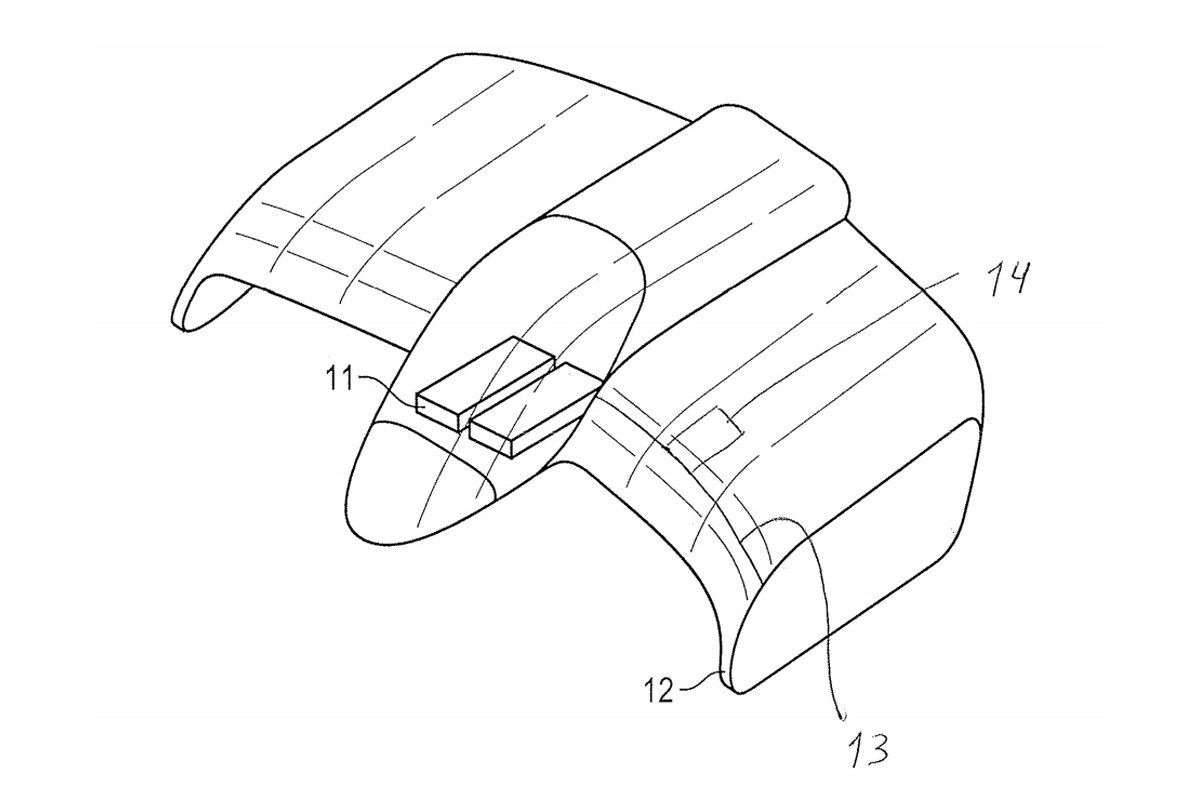
Porsche applied for a patent for an eVTOL aircraft on Jul. 3, 2019, and a patent for a power supply for an aircraft and corresponding aircraft on Jul. 2, 2019. Both patents were published online on Jan. 9, 2020. The aircraft patent reveals the eVTOL has four ducted propellers. Two (2) sets of ducted propellers are on each side of the fuselage, in the front of the aircraft and two sets of ducted propellers on each side of the fuselage, in the rear of the aircraft. While at rest, the propellers are hidden by louvers. When the aircraft is in forward flight, only the back set of ducted propellers are used for forward flight and the front set of ducted propellers turned off and louvers close over them, for better aerodynamics.
One additional design concept revealed from the power supply for an aircraft and corresponding aircraft patent is when the eVTOL takes off, it is tethered to a smaller auxiliary drone with a battery as the drone's cargo. The eVTOL and battery drone take off together autonomously while the battery drone feeds electric power to the eVTOL (and the battery drone itself) for vertical flight until the eVTOL passenger aircraft transitions to forward flight. After the eVTOL passenger aircraft transitions to forward flight, the auxiliary drone releases itself and apparently returns to the landing pad where it took off. However, the patent doesn't give any specific details where the battery drone will land and recharge itself. (This patent could be for the eVTOL passenger aircraft or for other aircraft they are designing.)
October 2019 update
Currently the discussions by Porsche and Boeing is the aircraft's main function will be for personal urban air travel. There has been no talk about this eVTOL aircraft being used as a ridesharing air taxi. Also, no other versions or models are being discussed at this time.
Future
According to some news reports, this unnamed eVTOL concept design aircraft was cancelled due to the Covid-19 pandemic. The company predicts the future of Vertical Mobility or advanced air mobility (AAM), will include person eVTOL aircraft, on-demand air taxis, eVTOL rentals, eVTOL buses and eVTOL rescue operations. The company predicts the target date of a high volume eVTOL aircraft flying worldwide will be by 2035.
Specifications:
- Aircraft type: Passenger eVTOL concept design aircraft
- Piloting: Autonomous
- Capacity: 2 passengers
- Cruise speed: ~200 km/h (~124 mph)
- Propellers: Unknown
- Electric motors: Unknown
- Power source: Easily removed fast-charging high-performance battery packs
- Fuselage: Carbon fiber composite
- Windows: Canopy over the cockpit
- Wings: 1 blended low wing body. The ends of the main wing are shaped vertically and these vertical wing ends are with vertical stabilizers or a form of a winglet. The bottom of the wing tips also act as landing gear.
- Landing gear: Lands on the ends of the wing tips
- Safety features: Distributed Electric Propulsion (DEP) means having multiple propellers (or electric ducted fans) and multiple electric motors on an aircraft so if one or more propellers (or electric ducted fans) or some electric motors fail, the other working propellers (or electric ducted fans) and electric motors can safely land the aircraft. DEP provides safety through redundancy for passengers or cargo. There are also redundancies of critical components in the sub-systems of the aircraft providing safety through redundancy. Having multiple redundant systems on any aircraft decreases having any single point of failure.
Related Aircraft:
- Aurora Flight Sciences (Boeing) Pegasus PAV (prototype)
- Aurora Flight Sciences (Boeing) XV-24 LightningStrike (defunct)
- Boeing Cargo Air Vehicle CV1 (prototype)
- Boeing Cargo Air Vehicle CV2 (prototype)
- Boeing Cargo Air Vehicle IT1 (concept design)
- Boeing Cargo Air Vehicle IT2 (concept design)
- Porsche Boeing Unnamed J2 (concept design)
- Porsche Boeing Unnamed T2 (concept design)
Company Insights:
Resources:
- Porsche website
- Porsche Consulting, The Future of Vertical Mobility web page
- Porsche Consulting Study: The Future Of Vertical Mobility White Paper PDF online
- Porsche Facebook
- Porsche Twitter
- Porsche YouTube
- Boeing website
- Aurora Flight Sciences website
- White Paper: The Future of Vertical Mobility, Porsche, Mar. 2018
- Press Release: Porsche and Boeing to Partner on Premium Urban Air Mobility Market, Boeing, Oct. 10, 2019
- Press Release: Porsche and Boeing to Partner on Premium Urban Air Mobility Market, Porsche, Oct. 10, 2019
- Article: Porsche is building an electric vertical take-off and landing aircraft (eVTOL) with Boeing, Electrek, Oct. 10, 2019
- Article: Porsche and Boeing collaborate on 'premium', propeller-free eVTOL aircraft, Institution of Mechanical Engineers, Oct. 10, 2019
- Article: A sports car in the sky? Boeing and Porsche target urban air mobility market, Geek Wire, Oct. 10, 2019
- Article: Boeing Partners with Porsche, Electric VTOL News, Nov. 4, 2019
- Patent: Aircraft, Porsche, Filed: Jul. 3, 2019, Published: Jan. 9, 2020
- Patent: Power supply for an aircraft and corresponding aircraft, Porsche, Filed: Jul. 2, 2019, Published: Jan. 9, 2020
- Article: Porsche applies to patent an all-electric VTOL flying taxi, Autoblog, Jan. 13, 2020

Recent Pages
- SMD Shenzhen Smart Drone UAV Bullet (production model)
- DreamFly Aerotech DF3000 Youlong (prototype)
- aeroG Aviation AG-8 (concept design)
- NASA Tiltwing-Two (illustration)
- CoolFly Urban 4 (concept design)
- CoolFly Standing Flight Platform (prototype)
- CoolFly Urban 3 (prototype)
- CoolFly Urban 2 (concept design)
- CoolFly Urban (production model)
- CoolFly Dream ST (production model)