Sabie ADIFO (technology demonstrator)
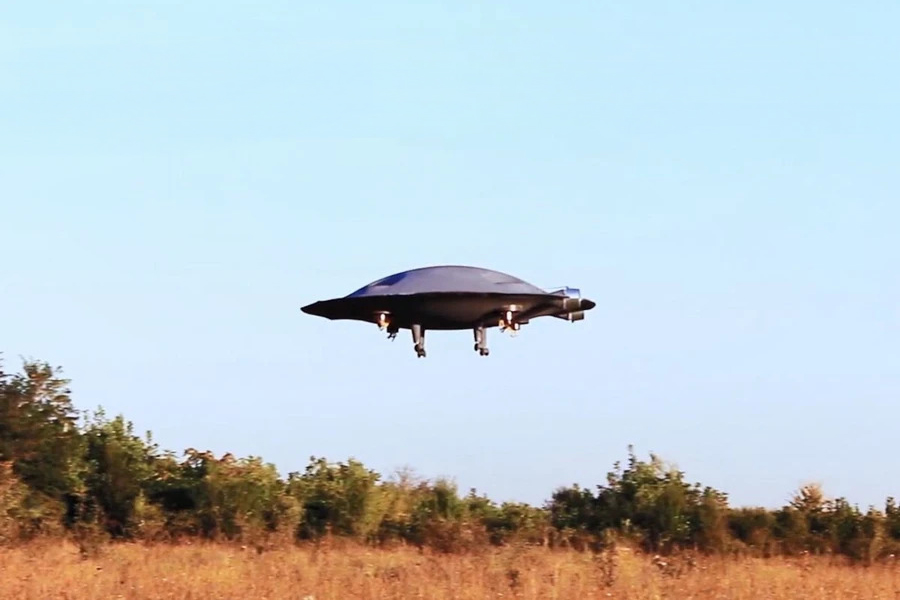
ADIFO (technology demonstrator)
Razvan Sabie
Bucharest, Romainia
www.adifoaircraft.com
Razvan Sabie is based in Bucharest, Romania. Sabie has invented and designed an electric vertical takeoff and landing (eVTOL) and a hybrid-electric VTOL passenger aircraft for advanced air mobility (AAM). Sabie also has a patent on his ADIFO aircraft design. (Image credit: Razvan Sabie)
ADIFO eVTOL subscale technology demonstrator aircraft
The ADIFO is a remote piloted eVTOL subscale technology demonstrator aircraft. ADIFO stands for All DIrections Flying Object. The aircraft's design looks like a classic UFO (a saucer shape) and because of this design, the inventor has stated the production model will have subsonic, supersonic and stealth capabilities. The inventor has stated he was not inspired from the classic UFO shape but from the back cross-section of a dolphin's airfoil. According to Sabie, the fuselage is the wing. The aircraft is scalable.
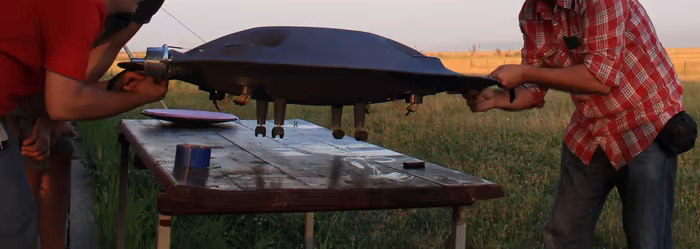
Successful test flights have been made by the inventor but no data has been provided about the test flights. The first test flight date, the cruise speed of the aircraft and how many test flights have been made is unknown. The subscale technology demonstrator has six electric ducted fans (EDFs) for all phases of flight. The demonstrator aircraft is powered by battery packs. The production model will have two jet engines for forward flight and use a hybrid-electric power source. No flight specifications for the demonstrator, such as cruise speed or maximum payload weight have been released by the company as of December 2023. The demonstrator's fuselage has a diameter of 1.2 meters (3.9 feet). The technology demonstrator has fixed quadricycle wheeled landing gear
The aerodynamic body is axial symmetric and can fly in all directions around the aircraft's axis that is perpendicular on the middle of the chord line. This is why the inventor has stated the ADIFO is capable of flying in all directions without any loss of aerodynamic ability. The production aircraft will have two lateral thrust nozzles pointed out to each side, which operate like the reaction control system thrusters on a spacecraft. The power source for the aircraft will be a hybrid-electric power source. The fuselage will be made from a carbon fiber composite material for a high strength to low weight ratio. The final production model will have retractable landing gear.
In addition, the Sabi states the aircraft has a high lift to drag ratio, has a uniform distribution of the aerodynamic load, has no stagnation point. The aircraft is predicted to have low vibrations, low noise, low heating of the fuselage and high fuel economy at high speeds. Drag is reduced at high speeds providing a high fuel economy. The inventor states there will be a smooth transition from subsonic to supersonic speeds with no sonic boom. The aircraft can fly upside down at low and at high speeds. The aircraft can also stop fast in mid-air and change directions.
The inventor foresees his aircraft to be used for personal air transportation, air cargo service and for military service. The inventor also states the aircraft would be well suited as a suborbital aircraft.

Specifications:
- Aircraft type: eVTOL subscale technology demonstrator aircraft
- Piloting: Remote piloting
- Cruise speed: Unknown
- Maximum payload weight: Unknown
- Propellers: 6 electric ducted fans (EDFs), for VTOL and forward flight
- Electric motors: 6 electric motors
- Power source: Battery packs
- Fuselage material: Unknown
- Fuselage diameter: 1.2 m (3.9 ft)
- Landing gear: Fixed quadricycle wheeled landing gear
- Safety features: Distributed Electric Propulsion (DEP), provides safety through redundancy for its passengers and/or cargo. DEP means having multiple propellers (or ducted fans) and motors on the aircraft so if one or more propellers (ducted fans) or motors fail, the other working propellers (or ducted fans) and motors can safely land the aircraft. There are also redundancies of critical components in the sub-systems of the aircraft.
Related Aircraft:
- Sabie ADIFO (concept design)
- Sabie Mad Bat (concept design)
- Sabie Mad Bat (technology demonstrator)
Resources:
- ADIFO website
- Mad Bat website
- Patent: Aircraft with vertical takeoff and landing and its operating process, Google Patents, Aug. 10, 2021
- Article: ADIFO: The hyper-agile, omnidirectional, supersonic flying saucer, New Atlas, Mar. 25, 2019
- Article: Terrestrial Flying Saucer Technology Could Revolutionize the Way We Fly, Interesting Engineering, Mar. 29, 2019
- Article: Romanian Engineers Have Created a Fully Functional Flying Saucer, Vice, Aug. 7, 2019
- Video: ADIFO, Василий Сычев, July 1, 2019

Recent Pages
- SMD Shenzhen Smart Drone UAV Bullet (production model)
- DreamFly Aerotech DF3000 Youlong (prototype)
- aeroG Aviation AG-8 (concept design)
- NASA Tiltwing-Two (illustration)
- CoolFly Urban 4 (concept design)
- CoolFly Standing Flight Platform (prototype)
- CoolFly Urban 3 (prototype)
- CoolFly Urban 2 (concept design)
- CoolFly Urban (production model)
- CoolFly Dream ST (production model)