Skyfly Technologies Axe (prototype)
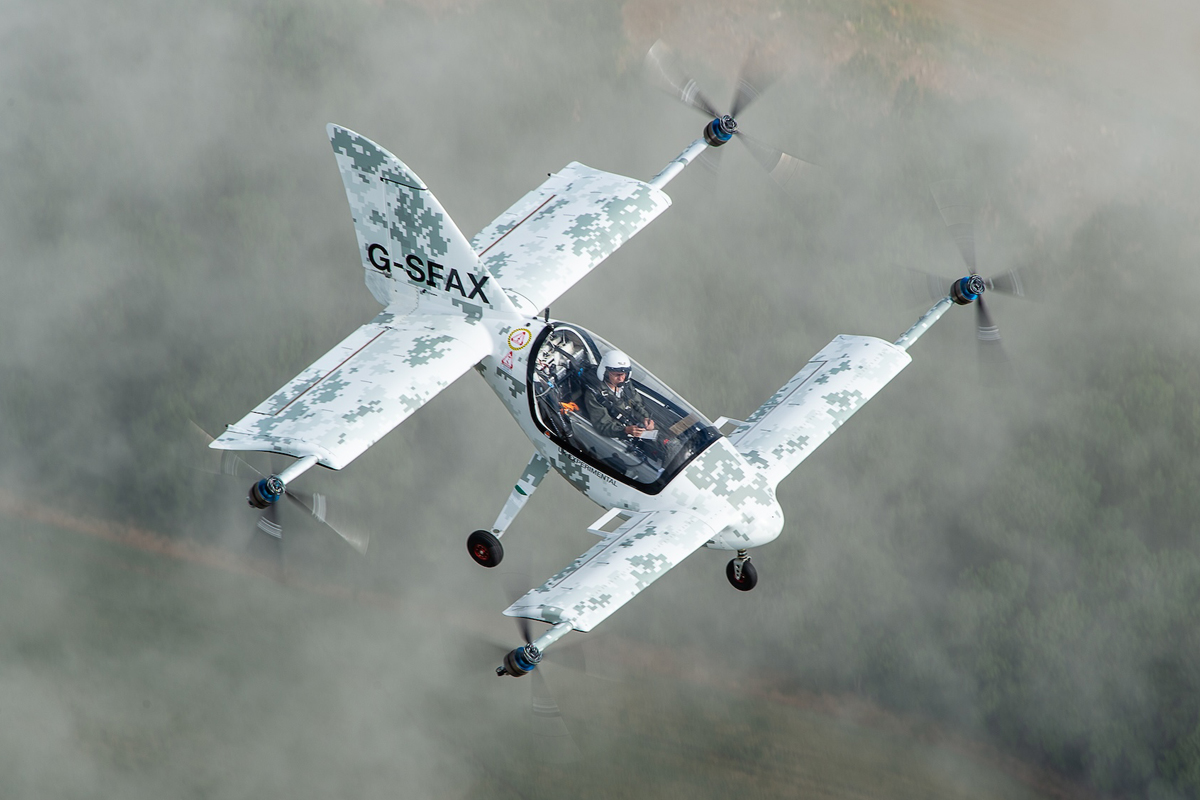
(Photo credit: Skyfly Technologies)
Axe (prototype)
Skyfly Technologies Ltd
Thorpe Mandeville, East Midlands, England, United Kingdom
www.skyfly.aero
Founded in 2019, Skfly Technologies Ltd designs, manufacturers and sells electric vertical take-off and landing aircraft (eVTOL) passenger and hybrid-electric VTOL passenger aircraft. Skyfly Technologies' CEO is Michael Thompson and the company is based in Thorpe Mandeville, East Midlands, England, United Kingdom. The company foresees selling its initial aircraft for personal air transportation and in the future, expects their air cargo aircraft to be used by government and defense use. The company has made and flown subscale prototypes, validating the technical aspects of their aircraft design.
In October 2026, Skyfly Technologies closed a $10 million seed round led by HICO Investment Group with Archangel to take the Axe aircraft from a flying prototype to certified production aircraft. The funding completes the Federal Aviation Administration's (FAA) light-sport aircraft certification of the Axe under the new FAA Modernization of Special Airworthiness Certification (MOSAIC) rules ahead of first customer deliveries expected in 2027. This certification will also accelerate the certification of the hybrid-propulsion system for the autonomous air cargo Longbow aircraft which the company plans to sell to government and defense customers.
Axe VCA passenger eVTOL aircraft (prototype)
The Axe VCA (vertically-capable aircraft) is a sub-scale one passenger eVTOL prototype aircraft. The aircraft has a canopy over the cockpit for excellent views for the pilot. The prototype has a tail number of G-SFAX. The company reported they built the prototype aircraft in just over four months.
The prototype has four fixed propellers, eight electric motors and is powered by high-capacity lithium-ion batteries. The empty weight of the aircraft is 550 kg (1,213 lb) including batteries, the maximum payload weight is 200 kg (441 lb) and the maximum takeoff weight is 750 kg (1,654 lb). The aircraft has tandem wings with a convention tail. The fuselage is made from carbon fiber composite to give the aircraft a high strength to low weight ratio. The aircraft has fixed tricycle wheeled landing gear.
2022. Flying the aircraft and estimated pricing
In 2022, Skyfly stated if you can fly a drone, you can learn to fly the Axe VTOL aircraft in about an hour because the controls are similar to a drone. The company has estimated the aircraft will sell for £150,000.00 ($180,566.00 USD). The company expects their aircraft to be in production in 2024.
On Feb. 1, 2023, the company announced that Edwin Brenninkmeyer, founder and CEO of Oriens Aviation, has invested in Skyfly Technologies. Brenninkmeyer is not only an accomplished business and venture capitalists but he is also a commercial and private pilot and flies corporate jets to performing aerobatics in high-performance former military jets.
On Mar. 23, 2023, the company announced that Bill Minkoff is investing in Skyfly Techologies. Minkoff is a former US Navy fighter pilot with 300 carrier landings, was an instructor at the Navy Strike Fighter Weapons School and was a Line Check Captain with Delta Airlines. Minkoff has also had a successful career selling private jets. He later founded AltiSky, the largest authorized sales and service center for Tecnam, an aircraft manufacturer headquartered in Italy. He also co-founded an advanced air mobility (AAM) consultancy company called Air Advisory LLC and has also consulted and worked for other aviation companies and organizations as well.
2024. The start of crewed prototype testing
The company reported before flight testing, the aircraft was put through two months of ground running. On October 16, 2024, Skyfly began crewed flight testing and achieved its first hover for the Axe VCA prototype. On November 20, 2024, the company reported the Axe VCA completed its first phase of manned hover flights.
2025. More prototype flight testing.
On March 7, 2025, the company reported the Axe prototype completed its first flights as a fixed-wing aircraft, meeting or exceeding all performance and handling expectations. These flights included circuit and stall testing. On Jund 30, 2025, Skyfly reported the Axe VCA prototype has conducted its first flights between two airfields, flying from Turweston to Bicester in the United Kingdom. The company stated this marks the first time in Europe that a crewed eVTOL aircraft was flown between two airfields. On November 14, 2025, Skyfly announced the crewed Axe VCA conducted the first test flights in the United States, following a six-month flight test campaign in the United Kingdom.
Preorders and first delivers expected in 2026
The company has been taking pre-orders since September 2022 and expect first deliveries of the Axe VCA production model in 2026.
Production Update
On September 23, 2026, the company stated on Facebook they are moving towards series production and their composites team has been refining the processes for their carbon fiber components. The aircraft will be made in the company's manufacturing and assembly facility in the United Kingdom with first deliveries planned for 2027.
Specifications:
- Aircraft type: Subscale passenger eVTOL aircraft (prototype)
- Piloting: 1 pilot during test flights
- Cruise speed: Unknown
- Empty weight: 550 kg (1,213 lb)
- Maximum payload weight: 200 kg (441 lb)
- Maximum takeoff weight: 750 kg (1,654 lb)
- Propellers: 4 fixed propellers
- Electric motors: 8 electric motors
- Power source: High-capacity lithium-ion batteries 70 kWh. Hover power required 200 kW. 280 kW peak. The batteries are housed in the fuselage and are easily swapped out for fully charged batteries.
- Fuselage: Carbon fiber composite
- Window: Canopy over cockpit
- Wings: Tandem wings
- Tail: 1 conventional tail
- Landing gear: Fixed tricycle wheeled landing gear
- Safety features: Distributed Electric Propulsion (DEP) uses multiple propellers or electric ducted fans, each powered by electric motors, to increase safety through redundancy. If one or more components fail, the remaining ones can still ensure a safe landing. There are also redundancies of critical components in the sub-systems of the aircraft providing safety through redundancy. Having multiple redundant systems on any aircraft decreases having any single point of failure. There is also a whole aircraft emergency ballistic parachute in case of an unexpected inflight emergency.
Related Aircraft:
- Skyfly Technologies Axe (concept design)
- Skyfly Technologies Axe (production prototype)
- Skyfly Technologies Longbow (concept design)
Company Insights:
Resources:
- Skyfly Technologies Ltd website
- Skyfly Technologies Ltd Facebook
- Skyfly Technologies Ltd Twitter
- Skyfly Technologies Ltd YouTube Channel
- Skyfly Technologies Ltd Instagram
- Skyfly Technologies Ltd LinkedIn
- Article: Skyfly begins orders for its ‘Axe’ 2-seat eVTOL, Transport Up, July 2, 2022
- Article: Skyfly Announces New eVTOL Aircraft, Plans to Begin Production in 2024, Avionics International, July 11, 2022
- Video: Axe E-VTOL by Skyfly - Official Launch, Skyfly, June 23, 2022
- Article: UK's Skyfly announces Axe eVTOL two-seater, Flyer, June 27, 2022
- Article: EVfly signs LOI for Axe by Skyfly eVTOLs, Vertical Magazine, Sept. 19, 2022
- Article: SkyFly Axe personal eVTOL flies in the sky, as the name suggests, New Atlas, Aug. 30, 2022
- Article: Norco to build fuselage, wings and composite components for Skyfly eVTOL aircraft, Composites World, Dec. 26, 2022
- Article: Oriens Aviation founder invests in Skyfly eVTOL, Vertical Magazine, Feb. 1, 2023
- Article: Air Courtage Assurances partners with Skyfly to provide insurance for private eVTOLs, Vertical Magazine, Feb. 22, 2023
- Article: Altisky invests in personal eVTOL developer Skyfly, Vertical Magazine, Mar. 23, 2023
- Article: Skyfly says FAA to recognize Axe eVTOL as a light sport aircraft, Vertical Magazine, Sept. 27, 2023
- Article: Skyfly begins crewed testing and carries out first hover of the Axe 2-seat VCA, Skyfly Technologies, Oct. 16, 2024
- Video: The Skyfly Axe eVTOL I The First Piloted Hover, Skyfly Technologies, Nov. 19, 2024
- Article: Skyfly’s Axe VCA completes first phase of manned test flights, Skyfly Technologies, Nov. 20, 2024
- Article: Skyfly closes new round of funding to expand engineering team and develop new powertrain and hybrid system, Skyfly Technologies, Jan. 22, 2025
- Article: Skyfly’s Axe VCA completes first piloted fixed-wing flights in major project milestone, Skyfly Technologies, Mar. 7, 2025
- Article: Skyfly Technologies Makes Aviation History with First Airfield-to-Airfield eVTOL Flight in Europe, Skyfly Technologies, June 20, 2025
- Article: Skyfly Conducts First Piloted Flights in North America and establishes US-based Flight Test Team, Skyfly Technologies, Nov. 14, 2025

Recent Pages
- Wuhan Xunqi Technology V1000B (prototype)
- Wuhan Xunqi Technology V1000A (prototype)
- Dragale Aviation DX-1 AyuRather (concept design)
- Dragale Aviation eVTOL Air Ambulance (concept design)
- Dragale Aviation AYUDX2 (concept design)
- Skyfly Technologies Longbow (concept design)
- Skyfly Technologies Axe (production prototype)
- Alef Aeronautics Model Zero Ultralight (pre-production model)
- SMD Shenzhen Smart Drone UAV Bullet (production model)
- DreamFly Aerotech DF3000 Youlong (prototype)