Teledrone Mark VIII (prototype)
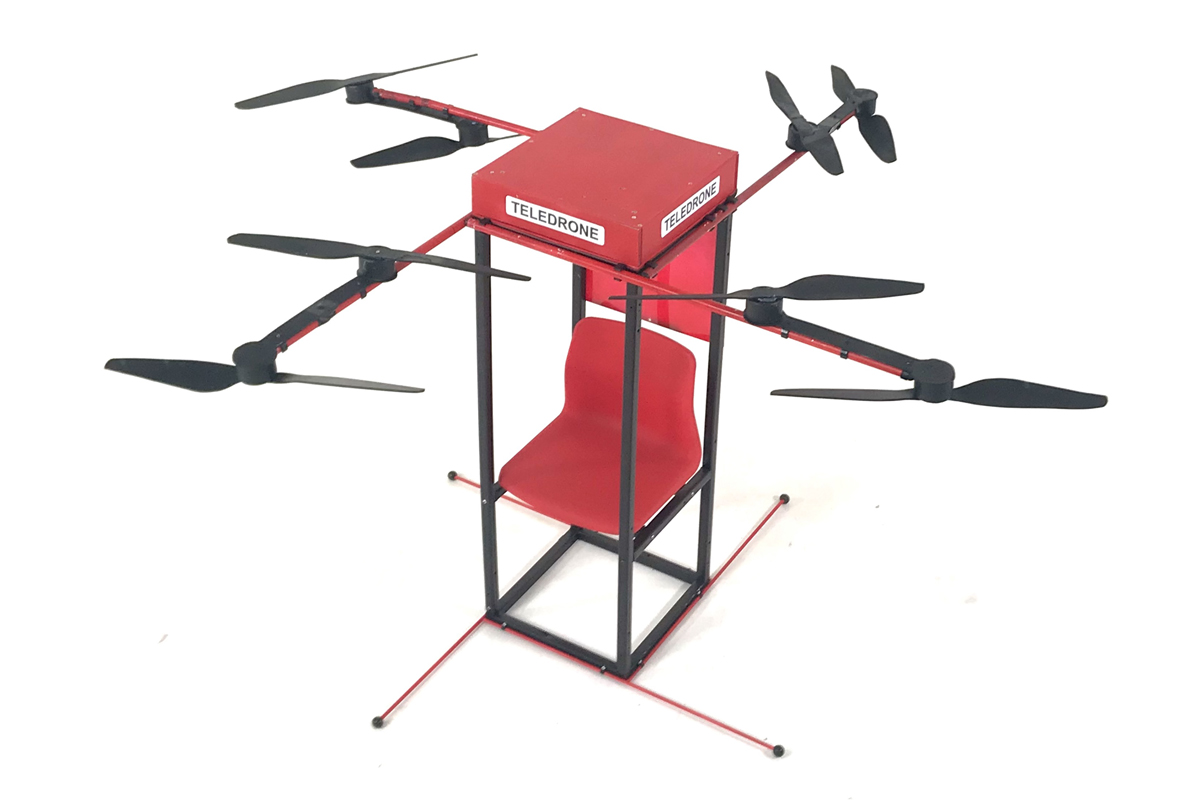
(Photo credit: Teledrone)
Teledrone Mark VII (prototype)
Teledrone Ltd.
Skelmersdale, Lancashire, United Kingdom
www.teledrone.com
www.teledrone.blogspot.com
Teledrone was incorporated by Colin Hilton, Director, in Skelmersdale, Lancashire, United Kingdom as a means of entry to the GoFly Challenge (Sponsored by Boeing in the USA). The Teledrone Project was one of 31 to qualify for the second phase of the GoFly Challenge, having been established to investigate the potential of an affordable passenger electric vertical takeoff and landing (eVTOL) aircraft for advanced air mobility (AAM). The GoFly Challenge was terminated in 2020 and has since been dissolved.
As Hilton has stated, his eVTOL multicopter aircraft are to be used to "teleport" passengers by the simplest of means or nearly as simple as making a phone call. Because of this, he decided to fashion his eVTOL multicopter design after the iconic public red telephone boxes found throughout the United Kingdom. Hence the Teledrone portmanteau for his eVTOL aircraft, blending the words red telephone box and drone.
Hilton has over 10,000 command hours (flight time logged) on Boeing and Airbus types and is a qualified airline pilot trainer. Previous inventions of his were financed by the British Technology Group (BTG), and demonstrated to Margaret Thatcher’s Minister of Technology and the National Physical Laboratory.
As of 2025, Hilton has turned from developing means of personal air mobility to employing the same methods to construct maritime drones. The principal reasons for so doing are the fact that there is little or no innovation in the platforms that such systems are based upon, whilst they would potentially benefit from the same sort of progress seen in the substitution of aerial drones for regular aircraft. In terms of developmental costs too, such drones benefit from a wholesale reduction in both material costs and external regulation.
Teledrone Mark VIII subscale passenger eVTOL multicopter (prototype)
The Teledrone Mark VIII is a 3/4 subscale passenger eVTOL multicopter. The prototype has luggage stowage underneath the pilot's seat. In December 2018, Hilton started his Teledrone blog posts. His first Teledrone was a non-working full-scale mock-up. The remote controlled Teledrone Mark VIII is his eighth flying prototype. If his full-scale prototypes were eventually made and more rigorous flight testing would be needed, the multicopter could be flown either by remote control or a test pilot.
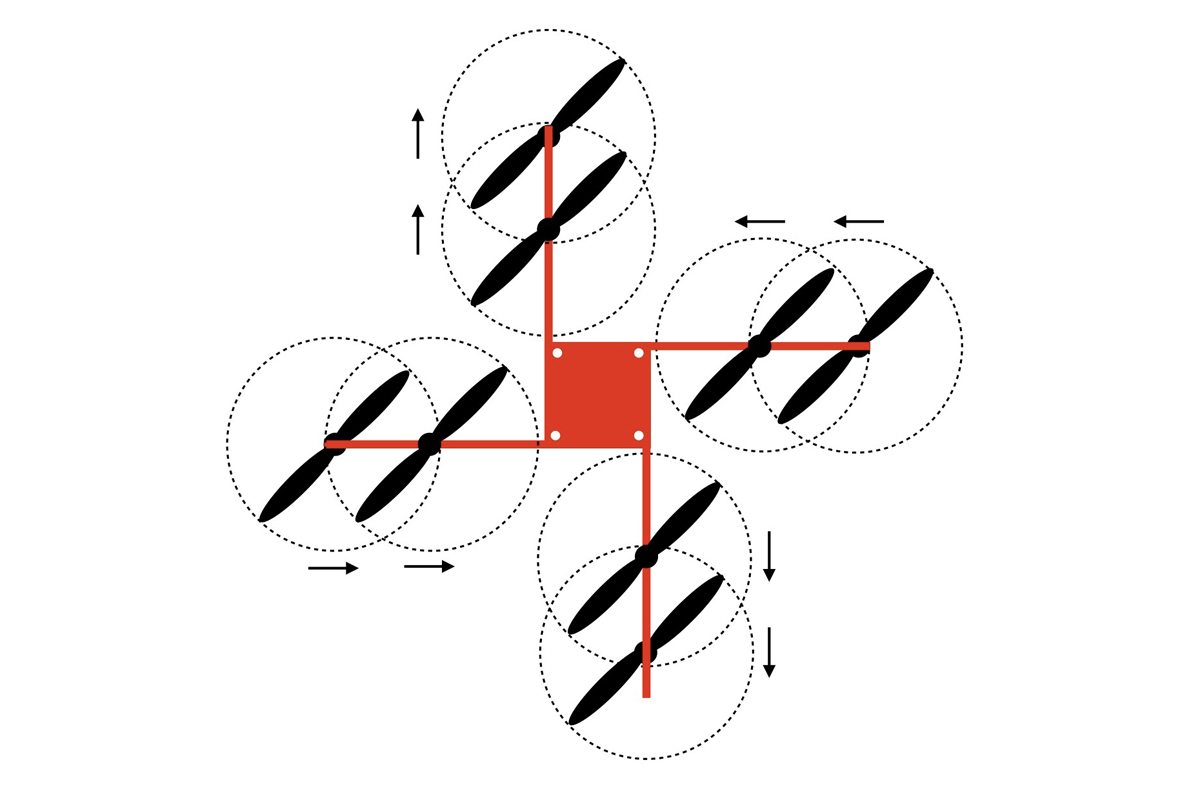
The Teledrone has eight propellers, eight electric motors and is powered by battery packs. Each set of propellers are counter-rotating propellers. The fuselage is made from steel alloy tubing, sheet metal, plywood and other materials. The width and length of the prototype is 15 in (38.1 cm) square. The overall width of the aircraft with propellers is 61 in (154.94 cm). The multicopter lands on the bottom of the fuselage with 4 horizontal Glass Reinforced Plastic (GRP) tubes, to steady the aircraft when on the ground.
Hilton has experimented with many different configurations of multicopter propeller placement. You can see various propeller configurations here on his Teledrone blog here. Hilton states that his current propeller placement on the Mark VIII is more efficient than the standard X configuration found on many multicopter aircraft and drones. Hilton mentions in his blog posts that he does everything to keep his cost down when building prototypes. Building a subscale prototype also helps to reduce the costs of building a prototype. For production aircraft, Hilton recommends the use of carbon fiber composite material.
Specifications:
- Aircraft type: 3/4 subscale passenger eVTOL multicopter (prototype)
- Piloting: Remote control
- Capacity: A small person or simulated payload. Luggage can be stowed underneath the passenger's chair.
- Cruise speed: Unknown
- Propellers: 8 propellers (Each set of propellers will rotate in opposite directions.)
- Electric motors: 8 electric motors (T-motor U7 V2 KV280 motors, using FLAME 80A v2 12S speed controllers)
- Power source: 6 battery packs (2,900 mAh Lipo battery packs)
- Fuselage: Square steel alloy tubing, sheet metal and plywood
- Width and length: 15 in (38.1 cm) square
- Overall width with propellers: 61 in (154.94 cm)
- Cockpit: Open cockpit
- Landing gear: Lands on the bottom of the fuselage with 4 horizontal Glass Reinforced Plastic (GRP) tubes, to steady the aircraft when on the ground
- Safety features: Distributed Electric Propulsion (DEP) uses multiple propellers or electric ducted fans, each powered by electric motors, to increase safety through redundancy. If one or more components fail, the remaining ones can still ensure a safe landing. There are also redundancies of critical components in the sub-systems of the aircraft providing safety through redundancy. Having multiple redundant systems on any aircraft decreases having any single point of failure. The aircraft has no moving surfaces or tilting parts when transitioning from vertical to forward flight and the reverse which increases safety by reducing complexity.
Related Aircraft:
- Teledrone (defunct)
- Teledrone Mark I (defunct)
- Teledrone Mark II (defunct)
- Teledrone Mark III (defunct)
- Teledrone Mark IV (defunct)
- Teledrone Mark V (defunct)
- Teledrone Mark VI (defunct)
- Teledrone Mark VII (prototype)
Resources:
- Teledrone website
- Teledrone Blogspot website
- Collin Hilton YouTube Channel
- Article: Meet the Teams: Get to Know Team Teledrone, From the United Kingdom, Go Fly Prize, Jan. 15, 2019

Recent Pages
- SMD Shenzhen Smart Drone UAV Bullet (production model)
- DreamFly Aerotech DF3000 Youlong (prototype)
- aeroG Aviation AG-8 (concept design)
- NASA Tiltwing-Two (illustration)
- CoolFly Urban 4 (concept design)
- CoolFly Standing Flight Platform (prototype)
- CoolFly Urban 3 (prototype)
- CoolFly Urban 2 (concept design)
- CoolFly Urban (production model)
- CoolFly Dream ST (production model)