Trek Aerospace SoloTrek Springtail EFV (prototype)
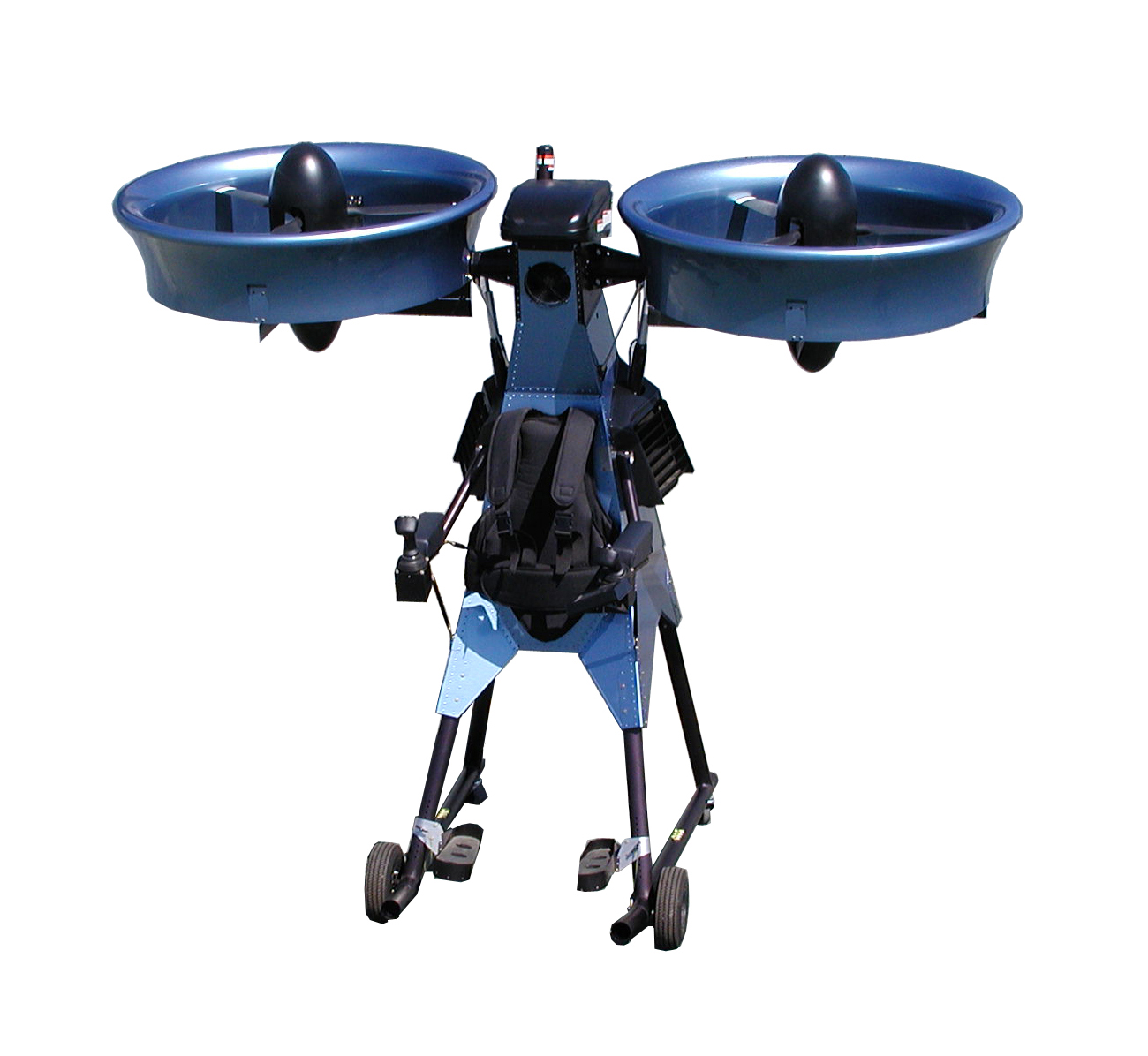
(Photo credit: Trek Aerospace)
SoloTrek Springtail EFV (prototype)
Trek Aerospace, Inc.
Folsom, California, USA
www.trekaero.com
Trek Aerospace, Inc. is a small engineering company based in Folsom, California, USA. Founded on March 18, 1996 as “Millennium Jet, Inc.”, the company changed their name to Trek Aerospace on July 3, 2002 because people thought the company was building jets. To clarify, SoloTrek was a name for certain models of Trek Aerospace's aircraft. SoloTrek was never the name of the company. The company is dedicated to understanding and improving shrouded propeller performance and efficiency. In the process, they developed their own proprietary CFD (Computational Fluid Dynamics) software, TASPA (Trek Aerospace Shrouded Propeller Analysis).
The company has stated all of their aircraft designs are very flexible when it comes to scalability, electric motors used, propeller types and the type of power source used. That is, all previous conventionally powered aircraft the company has created can be converted to eVTOL aircraft and can be updated with the latest in avionics, electronics, propellers and electric (all batteries or hybrid-electric) power sources. All of the company's aircraft have been designed for advanced air mobility (AAM).
The company has designed and made multiple vertical takeoff and landing (VTOL) aircraft including its exoskeleton backpack "helicopters" using shrouded propellers in the airframe design. Some articles refer to the exoskeleton backpack helicopter as a jetpack, even though there are no jet engines involved in the backpack aircraft. The company has also designed and made watercraft. Trek Aerospace also assists and teams with other companies, large and small, in the design, fabrication, and licensing of projects involving shrouded propellers and/or autonomous control systems. For example, Trek Aerospace built XTI Aircraft Company's TriFan subscale proof of concept (POC) aircraft.
Trek Aerospace Shrouded Propeller Analysis
Testing at NASA and university wind tunnels has validated the accuracy of the Trek Aerospace Shrouded Propeller Analysis (TASPA). Flight testing of both crewed and uncrewed vehicles has further verified the real-world applications of Trek’s technology. The company states their core technology has the highest specific thrust (lb/kW) in the industry. Aircraft designed by Trek define the efficiency curve used in the UBER Elevate white paper.
This efficiency allows aircraft to carry more weight in a smaller footprint. According to the company, their shrouded propellers require less power, use fewer batteries, have a greater payload and have a farther range than other battery powered aircraft. Furthermore, the company states their shrouded propellers have outperformed similar free propellers to airspeeds in excess of 230 mph (371 km/h), negating much of the drag penalty associated with ducted propellers.
SoloTrek Springtail EFV passenger hybrid-electric VTOL backpack helicopter prototype aircraft
The SoloTrek Springtail EFV (Exoskeleton Flying Vehicle) is a one passenger VTOL backpack "helicopter" which was powered by a Wankel-type rotary engine and had drive shafts and gear boxes to turn two fixed-pitch ducted counter-rotating blades. The SoloTrek Springtail EFV is an evolution of Trek Aerospace’s SoloTrek XFV
However, the company has stated this and all their aircraft can be converted to an all electric VTOL or hybrid-electric VTOL aircraft. By retrofitting this particular aircraft with new eVTOL technologies that exist today, the aircraft would become lighter, safer, quieter, more stable, more flight worthy, more reliable and possibly have a longer flight range.
The pilot's controls are two joysticks, one for direction and the other for altitude. The aircraft is controlled by a fly-by-wire computer system that can tilt each fan individually to control pitch and yaw. Control vanes in the exit of the ducts control roll and augment pitch control. The cruise speed of the aircraft is 82 mph (132 kph) and has a maximum speed of 98 mph (158 kph). The range of the aircraft is 160 miles (257 km), has a flight time of 2.2 hours and has a maximum altitude of 11,400 ft (3,475 m).
The aircraft has two ducted propellers at the top of the fuselage on either side of the pilot and was powered by a 2-stroke 118 hp Wankel rotary engine. The empty weight of the aircraft is 375 lb (170 kg), has a maximum payload weight of 175 lb (79 kg) and has a normal takeoff weight of 622 lb (282 kg).
The fuselage is made from aluminum honeycomb panels with fixed skid steel tube landing gear legs with quadricycle wheels. There is also a whole aircraft emergency ballistic parachute in case of an unexpected inflight emergency. A separate base-jumping parachute is worn by the pilot. The aircraft has two shoulder straps and a waist strap to secure the pilot to the fuselage.
Partial Timeline of the SoloTrek Springtail EFV Prototype
- SoloTrek XFV was damaged in a safety tether ingestion incident in December 2002
- SoloTrek Springtail EFV was a progression from the SoloTrek XFV
- New Design work started in early 2003 for the SoloTrek Springtail Prototype A which included larger ducts, a new powerplant and reengineered landing gear
- SoloTrek Springtail EFV Prototype A first tethered flight took place on October 2, 2003
- SoloTrek Springtail EFV Prototype A first non-tethered flight was just three weeks later, on October 20, 2003
- SoloTrek Springtail EFV Prototype A achieved its first transition to forward flight on November 5, 2003.
- SoloTrek Springtail EFV Prototype B with improved with variable pitched blades and was flight tested in 2005.
- At the end of the SoloTrek Springtail EFV program, efforts were underway to convert the vehicle to electric power, making it an eVTOL prototype aircraft
- There were at least four different generations of the SoloTrek Springtail EFV aircraft.
- By March 16, 2005, all the goals of the original DARPA contract for SoloTrek had been achieved
After the successful completion of the DARPA contract, there was no follow-on funding. Trek Aerospace moved on to other designs. During the Great Recession of 2007, the SoloTrek Springtail EFV aircraft was disassembled and sold for parts.

Specifications:
- Aircraft type: One person VTOL backpack helicopter prototype aircraft
- Piloting: 1 pilot
- Cruise speed: 82 mph (132 kph)
- Maximum speed: 98 mph (158 kph)
- Range: 160 miles (257 km)
- Flight time: 2.2 hours
- Maximum altitude: 11,400 ft (3,475 m)
- Empty weight: 375 lb (170 kg)
- Maximum payload weight: 175 lb (79 kg)
- Normal takeoff weight: 622 lb (282 kg)
- Maximum takeoff weight: 834 lb (378 kg)
- Propellers: 2 ducted counter-rotating propellers. Each propeller is 42 inches (1,067 mm) wide.
- Power source: 2-stroke 118 hp Wankel rotary engine. The aircraft can be easily configured with a hybrid-electric power source with a engine for the power and electric motors for the propellers.
- Fuselage: Aluminum honeycomb panels with steel tube landing gear legs
- Length: 5.31 ft (1.62m)
- Width: 9.71 ft (2.96m)
- Height: 8.26 ft (2.52m)
- Landing gear: Fixed skid landing gear with quadricycle wheels. Two foot rests are located on the aircraft's fixed skid landing gear.
- Safety features: There are redundancies of critical components in the sub-systems of the aircraft providing safety through redundancy. There is also a whole aircraft emergency ballistic parachute in case of an unexpected inflight emergency. A separate base-jumping parachute is worn by the pilot. The aircraft has two shoulder straps and a waist strap to secure the pilot to the fuselage.
Related Aircraft:
- Trek Aerospace Dragonfly (prototype)
- Trek Aerospace DuoTrek 1.0 (concept design)
- Trek Aerospace DuoTrek 2.0 (concept design)
- Trek Aerospace Elesi (concept design)
- Trek Aerospace FlyKart 1 (prototype)
- Trek Aerospace FlyKart 2 (prototype)
- Trek Aerospace FlyKart 3 (prototype)
- Trek Aerospace LogDrone (concept design)
- Trek Aerospace Mule (concept design)
- Trek Aerospace Nightingale (concept design)
- Trek Aerospace Nytngale (concept design)
- Trek Aerospace OAV-II (concept design)
- Trek Aerospace OVIWUN (production model)
- Trek Aerospace Scorpion (concept design)
- Trek Aerospace SoloTrek XFV (prototype)
- Trek Aerospace SoloTrek XFVC (concept design)
- Trek Aerospace SoloTrek XFVM (concept design)
- Trek Aerospace TERN (concept design)
- Trek Aerospace Tyrannos (concept design)
Company Insights:
Resources:
- Trek Aerospace website
- Trek Aerospace Twitter
- Trek Aerospace LinkedIn
- Trek Aerospace Wikipedia
- Article: The Springtail Exoskeleton Flying Vehicle, IdeaConnection, May 3, 2009
- Article: The Springtail Exoskeleton Flying Vehicle ideal for the quick getaway, New Atlas, May 3, 2009
- Article: Ducted Fan Designs Lead to Potential New Vehicles, NASA, 2010
- Article: Taking Flight: The Long Challenges of Product Development, Plastics Technology, Feb. 25, 2011
- Article: SoloTrek developers planning two seat electric hybrid Air Car, New Atlas, June 30. 2011

Recent Pages
- SMD Shenzhen Smart Drone UAV Bullet (production model)
- DreamFly Aerotech DF3000 Youlong (prototype)
- aeroG Aviation AG-8 (concept design)
- NASA Tiltwing-Two (illustration)
- CoolFly Urban 4 (concept design)
- CoolFly Standing Flight Platform (prototype)
- CoolFly Urban 3 (prototype)
- CoolFly Urban 2 (concept design)
- CoolFly Urban (production model)
- CoolFly Dream ST (production model)