Trek Aerospace TERN (concept design)
(Image credit: Trek Aerospace)
TERN (concept design)
Trek Aerospace, Inc.
Folsom, California, USA
www.trekaero.com
Trek Aerospace, Inc. is a small engineering company based in Folsom, California, USA. Founded on March 18, 1996 as “Millennium Jet, Inc.”, the company changed their name to Trek Aerospace on July 3, 2002 because people thought the company was building jets. To clarify, SoloTrek was a name for certain models of Trek Aerospace's aircraft. SoloTrek was never the name of the company. The company is dedicated to understanding and improving shrouded propeller performance and efficiency. In the process, they developed their own proprietary CFD (Computational Fluid Dynamics) software, TASPA (Trek Aerospace Shrouded Propeller Analysis).
The company has stated all of their aircraft designs are very flexible when it comes to scalability, electric motors used, propeller types and the type of power source used. That is, all previous conventionally powered aircraft the company has created can be converted to eVTOL aircraft and can be updated with the latest in avionics, electronics, propellers and electric (all batteries or hybrid-electric) power sources. All of the company's aircraft have been designed for advanced air mobility (AAM).
The company has designed and made multiple vertical takeoff and landing (VTOL) aircraft including its exoskeleton backpack "helicopters" using shrouded propellers in the airframe design. Some articles refer to the exoskeleton backpack helicopter as a jetpack, even though there are no jet engines involved in the backpack aircraft. The company has also designed and made watercraft. Trek Aerospace also assists and teams with other companies, large and small, in the design, fabrication, and licensing of projects involving shrouded propellers and/or autonomous control systems. For example, Trek Aerospace built XTI Aircraft Company's TriFan subscale proof of concept (POC) aircraft.
Trek Aerospace Shrouded Propeller Analysis
Testing at NASA and university wind tunnels has validated the accuracy of the Trek Aerospace Shrouded Propeller Analysis (TASPA). Flight testing of both crewed and uncrewed vehicles has further verified the real-world applications of Trek’s technology. The company states their core technology has the highest specific thrust (lb/kW) in the industry. Aircraft designed by Trek define the efficiency curve used in the UBER Elevate white paper.
This efficiency allows aircraft to carry more weight in a smaller footprint. According to the company, their shrouded propellers require less power, use fewer batteries, have a greater payload and have a farther range than other battery powered aircraft. Furthermore, the company states their shrouded propellers have outperformed similar free propellers to airspeeds in excess of 230 mph (371 km/h), negating much of the drag penalty associated with ducted propellers.
TERN uncrewed hybrid-electric VTOL concept design drone
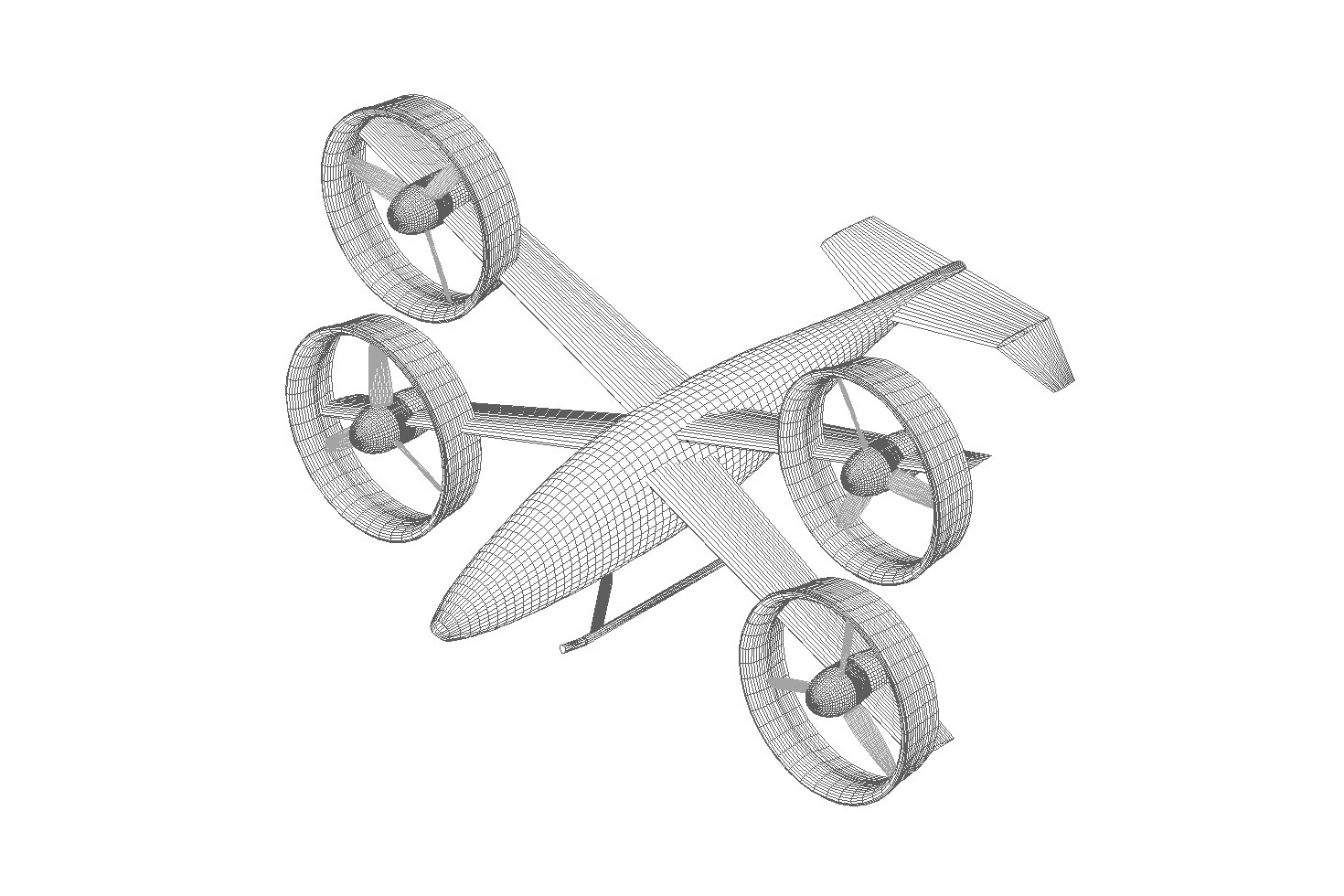
The Tactically Exploited Reconnaissance Node (TERN) is an uncrewed autonomous heavy-lift high-performance hybrid-electric VTOL concept design military drone with a unique X-wing design. The Defense Advanced Research Projects Agency (DARPA) on March 26, 2013, released BAA-13-28 the Tactically Exploited Reconnaissance Node (TERN) Program. Trek Aerospace teamed with Northrup-Grumman on the proposal, with Trek Aerospace supplying the following concept. Northrup-Grumman was eventually awarded a contract under this program but for a different concept.
DARPA's goal was to have an aircraft designed, developed and demonstrate a medium altitude, long-endurance, uncrewed aircraft vehicle (UAV) to enable launch, recovery and operations from small ships. The ultimate goal was to enable persistent intelligence, surveillance and reconnaissance (ISR), and have strike capabilities with payloads of 600 pounds (272 kg) while operating up to 1,035 miles (1,665 km) from a host vessel.
The cruise of the aircraft is estimated at 253 mph (407 km/h) and has a predicted maximum sustained speed of 276 mph (444 km/h). The targeted flight time is 9-1/2 hours and has a calculated maximum altitude of 32,500 ft (9,906 m). There are four ducted propellers, four electric motors and has a planned hybrid-electric power source.
The ducted propellers are located near the end of each X-wing. Each wing pivots allowing for all directions of flight. The rear empennage has one horizontal stabilizer and at the end of the horizontal stabilizer are inverted vertical stabilizers. The fuselage is made from carbon fiber composite to give the aircraft a high strength to low weight ratio. The aircraft has fixed skid landing gear. The foreseen empty weight of the aircraft is 1,854 lb (841 kg), has a desired maximum payload of 1,608 lb (729 kg) and has a proposed maximum takeoff weight of 3,462 lb (1,570 kg).
All specifications are estimated and a prototype was never made.
Specifications:
- Aircraft type: Heavy-lift hybrid-electric VTOL concept design military drone
- Piloting: Autonomous
- Capacity: 600 pounds (272 kg). Cargo would include intelligence, surveillance, reconnaissance equipment and carry missiles (or bombs) for strike capability.
- Cruise speed: 253 mph (407 km/h)
- Maximum sustained speed: 276 mph (444 km/h)
- Maximum burst speed: 432 mph (695 km/h)
- Range: 1,035 m (1,665 km)
- Flight time: 9-1/2 hours
- Maximum altitude: 32,500 ft (9,906 m)
- Empty weight: 1,854 lb (841 kg)
- Maximum payload: 1,608 lb (729 kg)
- Maximum takeoff weight: 3,462 lb (1,570 kg)
- Propellers: 4 ducted propellers
- Electric Motors: 4 electric motors (95 kW each motor)
- Power source: Hybrid-electric power source with 200 hp engine and battery packs
- Fuselage: Carbon fiber composite
- Wing span maximum width: 22.00 ft (3.797 m)
- Wing span stowed: 12.46 ft (6.70 m)
- Length: 19.04 ft (5.803 m)
- Height: 5.74 ft (1.749 m)
- Wings: 1 X-wing, pivoting wings (wings fold for compact stowage)
- Tail: 1 rear mounted horizontal stabilizer with two inverted vertical stabilizers
- Landing gear: Fixed skid landing gear
- Safety features: Distributed Electric Propulsion (DEP) uses multiple propellers or electric ducted fans, each powered by electric motors, to increase safety through redundancy. If one or more components fail, the remaining ones can still ensure a safe landing. There are also redundancies of critical components in the sub-systems of the aircraft providing safety through redundancy. Having multiple redundant systems on any aircraft decreases having any single point of failure.
Related Aircraft:
- Trek Aerospace Dragonfly (prototype)
- Trek Aerospace DuoTrek 1.0 (concept design)
- Trek Aerospace DuoTrek 2.0 (concept design)
- Trek Aerospace Elesi (concept design)
- Trek Aerospace FlyKart 1 (prototype)
- Trek Aerospace FlyKart 2 (prototype)
- Trek Aerospace FlyKart 3 (prototype)
- Trek Aerospace LogDrone (concept design)
- Trek Aerospace Mule (concept design)
- Trek Aerospace Nightingale (concept design)
- Trek Aerospace Nytngale (concept design)
- Trek Aerospace OAV-II (concept design)
- Trek Aerospace OVIWUN (production model)
- Trek Aerospace Scorpion (concept design)
- Trek Aerospace SoloTrek Springtail EFV (prototype)
- Trek Aerospace SoloTrek XFV (prototype)
- Trek Aerospace SoloTrek XFVC (concept design)
- Trek Aerospace SoloTrek XFVM (concept design)
- Trek Aerospace Tyrannos (concept design)
Company Insights:
Resources:
- Trek Aerospace website
- Trek Aerospace Twitter
- Trek Aerospace LinkedIn
- Trek Aerospace Wikipedia
- Northrop Grumman Tern Wikipedia
- Article: Tern: Tactically Exploited Reconnaissance Node, DARPA, 2013
- Article: Solicitation released for TERN program to operate long-endurance UAVs from small ships, Military+Aerospace, Apr. 1, 2013

Recent Pages
- SMD Shenzhen Smart Drone UAV Bullet (production model)
- DreamFly Aerotech DF3000 Youlong (prototype)
- aeroG Aviation AG-8 (concept design)
- NASA Tiltwing-Two (illustration)
- CoolFly Urban 4 (concept design)
- CoolFly Standing Flight Platform (prototype)
- CoolFly Urban 3 (prototype)
- CoolFly Urban 2 (concept design)
- CoolFly Urban (production model)
- CoolFly Dream ST (production model)