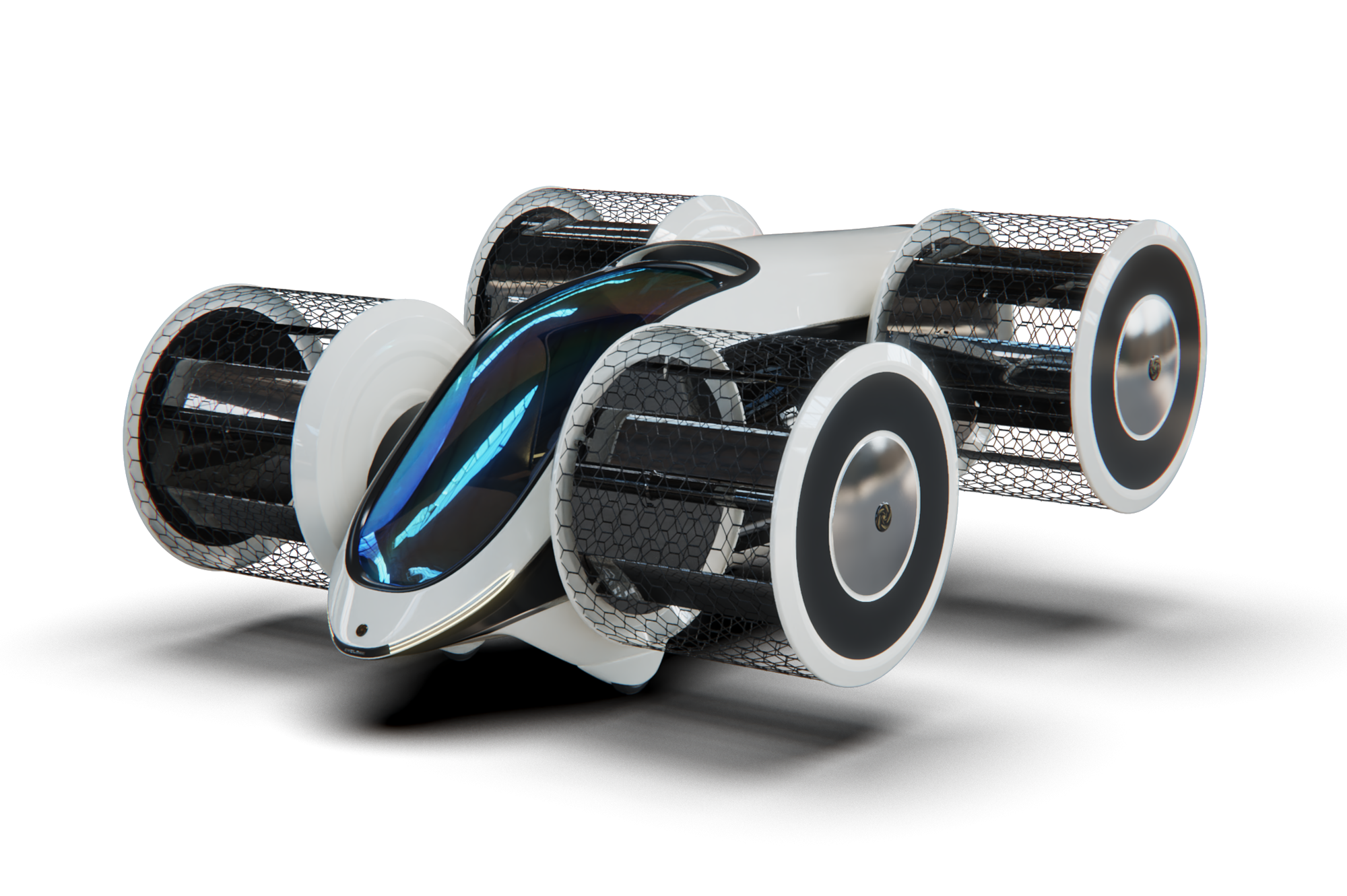
Advanced Research Foundation Cyclocar (concept design)
(Image credit: Advanced Research Foundation)
Cyclocar (concept design)
Advanced Research Foundation
Moscow, Russia
www.fpi.gov.ru
Based in Russia, the Advanced Research Foundation founded in 2012, is a research and development organization for Russia to modernize the military and state security organizations with innovative high-tech technologies and products and to also bring innovative products for civilian use. The Cyclocar Project Team Leader is Yan Chibisov.
In 2017, the Foundation for Advanced Study organized an open competition "Free Takeoff", to develop the best vertical takeoff or ultra-short takeoff and landing aircraft for Urban Air Mobility (UAM). In May 2017, Flash-M LLC was announced as the winner. The winning team proposed using cyclical propellers for their vertical takeoff and landing (VTOL) aircraft and this was the design base which Advanced Research Foundation's used for the Cyclocar.
Cyclocar autonomous passenger hybrid-electric VTOL aircraft (concept design)
The Cyclocar is an autonomous six passenger hybrid-electric VTOL aircraft uses cyclical propellers for VTOL and forward flight. Passengers can enter and exit on either side of the aircraft and from the rear of the aircraft.
The maximum speed of the Cyclocar is estimated at 250 km/h (155 mph), with a range of 500 km (311 miles), has no wings and has a fixed quadricycle wheeled landing gear arrangement. The Advanced Research Foundation says the vehicle can be equipped with a gasoline piston engine or a more powerful turbine engine its power source. A unique feature of the aircraft is its ability to land on an inclined surface of up to 30 degrees and to dock to vertical surfaces. The aircraft can also be used for air cargo service.
Some of the main advantages for this design is very fast control of thrust vectors through 360 degrees for excellent maneuverability in the air, has a low noise level and is a very compact vehicle. The aircraft will have a hybrid-electric power plant to create the electricity for the electric motors turning the cyclical propellers providing the power for VTOL flight, high speed flight and endurance for the aircraft. There is also safety shielding so passengers and ground crew are protected from the turning propellers. The aircraft has more safety features including being able to continue to fly if two of the four rotors stop working and the aircraft will also be equipped with a whole aircraft parachute.
The Cyclocar is expected to be used for both military and civilian use, including Urban Air Mobility, Search & Rescue, police work, fire fighting, tourism, surveying, transportation to the battle field and more. Its sister air cargo drone, the Cyclodron, is planned to be used in agriculture, monitoring the air, medicine and organ transportation, commercial cargo services and more.
In 2020, a 60 kg (132 lb) sub-scale prototype made its first flight validating its flight control systems, including the ability to fly the aircraft in VTOL flight and forward flight modes. The first full-size Cyclocar prototype is scheduled to fly in 2022 and production aircraft are expected to be manufactured by 2024.

Specifications:
- Aircraft type: Passenger or air cargo hybrid-electric VTOL aircraft (concept design)
- Piloting: Autonomous
- Capacity: 6 passengers
- Maximum speed: 250 km/h (155 mph)
- Range: 500 km (311 miles)
- Maximum payload: 600 kg (1,323 lb)
- Cyclical propellers: 4 cyclical propellers
- Electric Motors: Possibly 4 electric motors or more
- Power source: Hybrid-electric power source
- Fuselage: Carbon fiber composite
- Windows: Canopy over the passenger seating area
- Landing gear: Fixed quadricycle wheeled landing gear
- Safety Features: Distributed Electric Propulsion (DEP), provides safety through redundancy for its passengers and/or cargo. DEP means having multiple propellers and motors on the aircraft so if one or more motors or propellers fail, the other working motors and propellers can safely land the aircraft. Two of the cyclical propellers can stop working and the aircraft can continue to fly and land safely. The aircraft will also have a whole aircraft parachute system.
Company Insights:
Resources:
- Advanced Research Foundation website
- Advanced Research Foundation LinkedIn
Russian Foundation for Advanced Research Projects in the Defense Industry Wikipedia - Video: Cyclolette. Flight tests, Advanced Research Foundation, Sept. 4, 2020
- Article: Kommersant: Cyclodrons and cyclocars are the future basis of Russian air mobility, Advanced Research Foundation, Dec. 15, 2021
- Video: Cyclocar - a six-seater aeromobile with a hybrid power plant, Advanced Research Foundation, Apr. 15, 2021
- Video: Cyclodron. Flights with berthing to a vertical surface and landing on an inclined surface, Advanced Research Foundation, Apr. 16, 2021
- Article: Russia has started to create a flying car "Cyclocar", Ria RU, Apr. 16, 2021
- Article: Work has begun on the creation of a six-seater aeromobile with a hybrid power plant, Advanced Research Foundation, April 16, 2021
- Article: In Russia, the development of a flying car for six people began. It will accelerate to 250 km/h, Fontanka, Apr. 16, 2021
- Article: Cyclocar, Russia’s first flying car with a very futuristic look, Somag News, Apr. 19, 2021
- Article: Russia has flown prototypes of its six-seat hybrid VTOL Cyclocar, New Atlas, June 20, 2021

Recent Pages
- SMD Shenzhen Smart Drone UAV Bullet (production model)
- DreamFly Aerotech DF3000 Youlong (prototype)
- aeroG Aviation AG-8 (concept design)
- NASA Tiltwing-Two (illustration)
- CoolFly Urban 4 (concept design)
- CoolFly Standing Flight Platform (prototype)
- CoolFly Urban 3 (prototype)
- CoolFly Urban 2 (concept design)
- CoolFly Urban (production model)
- CoolFly Dream ST (production model)