Wuhan Xunqi Technology V1000A (prototype)
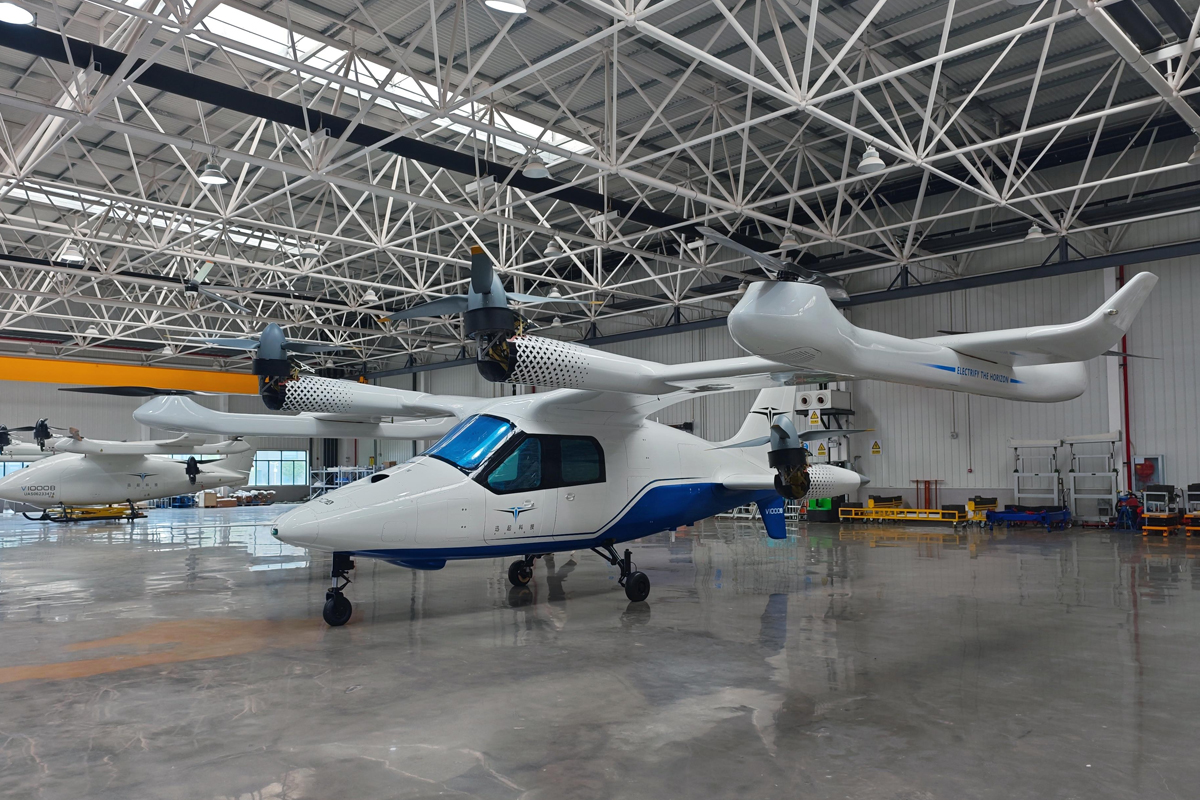
(Photo credit: Wuhan Xunqi Technology)
V1000A (prototype)
Wuhan Xunqi Technology
Wuhan, Hubie Province, China
(website unknown)
The information provided here is as accurate as possible; however, eVTOL information from China is sometimes sparse, incomplete or conflicting. China is promoting what they call the "low-altitude economy"—a new push for general aviation—which includes both crewed and uncrewed passenger and air cargo eVTOL aircraft.
Located in Wuhan, Hubie Province, China, the Wuhan Xunqi Technology company is in the business of designing and manufacturing long-range passenger and air cargo hybrid-electric VTOL aircraft for the nascent advanced air mobility (AAM) industry. As of 2026, the company has made a passenger and an air cargo hybrid-electric VTOL aircraft. We can't find the company's website.
According to some news reports from China, the V1000A (the passenger aircraft) and V1000B (the air cargo aircraft) are the first large tilt-propeller hybrid-electric eVTOL aircraft to receive Civil Aviation Administration of China (CAAC) Type Certificate (TC) approval.
V1000A long-range passenger hybrid-electric VTOL aircraft (prototype)
The V1000A is a long-range passenger hybrid-electric VTOL working prototype aircraft. The prototype carries one pilot and three passengers. The production model is expected to hold six people. On the one side of the aircraft's boom are the words, "Electrify the Horizon". The company foresees their aircraft to first be used for on-demand air taxi service and tourist flights.
The range of the aircraft has been reported to be 1,000 km (621 m) and has an expected maximum payload weight of 600 kg (1,323 lb). The aircraft has eight propellers, eight electric motors and is powered by a hybrid-electric power source. The aircraft has one high main wing with winglets, one standard vertical stabilizer, one inverted vertical stabilizer and two horizontal stabilizers mounted on the rear of the fuselage near the tail of the aircraft. The tilt-propellers are located on the high main wing and the two rear horizontal stabilizers. The VTOL-only propellers are on the front and rear of the two booms on the aircraft.
The fuselage is made from carbon fiber composite to give the aircraft a high strength to low weight ratio. The aircraft has fixed tricycle wheeled landing gear.
Additional information
The first V1000A passenger prototype was rolled off the line on April 16, 2026. The V1000A prototype is expected to fly in June 2026. On June 24, 2026, the company completed ground tests of the crewed prototype.
Expected price
As of April 2026, the company's projected price of the aircraft is ¥10-15 million yuan CNY ($1.5-2.25 million USD) as of April 2026.
Specifications:
- Aircraft type: Long-range passenger hybrid-electric VTOL aircraft (prototype)
- Piloting: 1 pilot
- Capacity: 3 passengers
- Cruise speed: Unknown
- Range: 1,000 km (621 m)
- Maximum payload weight: 600 kg (1,323 lb)
- Propellers: 8 propellers (6 tilt-propellers on high main wing and small stub wings located on the rear of the fuselage but in front of the tail, 4 VTOL-only propellers on booms)
- Electric motors: 8 electric motors
- Power source: Hybrid-electric power source
- Fuselage: Carbon fiber composite
- Windows: General aviation type windows
- Wings: 1 high main wing with winglets
- Tail: 1 vertical stabilizer with 1 small inverted stabilizer. There is also a horizontal stabilizer on the rear fuselage near the vertical stabilizers.
- Landing gear: Fixed tricycle wheeled landing gear
- Safety features: Distributed Electric Propulsion (DEP) uses multiple propellers or electric ducted fans, each powered by electric motors, to increase safety through redundancy. If one or more components fail, the remaining ones can still ensure a safe landing. There are also redundancies of critical components in the sub-systems of the aircraft providing safety through redundancy. Having multiple redundant systems on any aircraft decreases having any single point of failure.
Related Aircraft:
- Wuhan Xunqi Technology V1000B (prototype)
Resources:
- Wuhan Xunqi Technology (website unknown)
- Article: HRC Supports Final Assembly Rollout of Xunqi V1000A Manned Tiltrotor Hybrid eVTOL, Group HRC, Apr. 23, 2026
- Article: HRC-Enabled Xunqi V1000A Manned eVTOL Completes Final Assembly, China Composites Expo, May 20, 2026
- Article: What does it feel like to sit in the air? Xunqi Technology V1000A manned prototype is about to fly for the first time, News QQ, July 24, 2026

Recent Pages
- Wuhan Xunqi Technology V1000B (prototype)
- Wuhan Xunqi Technology V1000A (prototype)
- Dragale Aviation DX-1 AyuRather (concept design)
- Dragale Aviation eVTOL Air Ambulance (concept design)
- Dragale Aviation AYUDX2 (concept design)
- Skyfly Technologies Longbow (concept design)
- Skyfly Technologies Axe (production prototype)
- Alef Aeronautics Model Zero Ultralight (pre-production model)
- SMD Shenzhen Smart Drone UAV Bullet (production model)
- DreamFly Aerotech DF3000 Youlong (prototype)