Bivect Air Rogue (concept design)
(Image credit: Bivect Air)
Rogue (concept design)
Bivect Air, Inc.
Sainte-Marie-Saint-Raphaël, New Brunswick, Canada
www.gary-gress.pixels.com
Gary Robert Gress, a Canadian mechanical engineer and lifelong aviation innovator is the sole principal of Bivect Air. Gress has has developed multiple two propeller passenger electric vertical takeoff and landing (eVTOL) for advanced air mobility. His approach to aircraft design blends decades of aerospace engineering experience with a deep curiosity for vertical takeoff and landing (VTOL) history—from early helicopter concepts to modern gyroscopic control systems.
GoFly Competition
Gress entered the GoFly Phase II Competition with the Rogue model and attended the February 2020 flyoff at Moffett Field in San Francisco, California, USA. He submitted a 1/3-scale prototype. 28 of the 30 entries were full-scale prototypes. The two sub-scale entries weren't allowed to compete in the race but it turned out that no aircraft was capable of flying the circuit.
Some background information about Gress
After retiring around 2012, he returned to school to complete his M.Sc. and Ph.D. in Mechanical Engineering at the University of Calgary, with the goal of fully understanding the control of hovering aircraft. His design teacher, who was not in the aerospace industry, taught Gary an invaluable lesson that has spurred him to continue even when he confronts seemingly insurmountable barriers. He once said to the class: "It takes a lot of work to make something simple," he remembers. "I think that is so true and it applies everywhere.," Gress said.
Transitioning eVTOL Aircraft with Augmentative Cross-Modal Elements White Paper
Gress presented "Transitioning eVTOL Aircraft with Augmentative Cross-Modal Elements" at Forum 80, sponsored by the Vertical Flight Society, May 7–9, 2024, Montréal, Québec, Canada. His proposition boiled down, is that two propellers are the right amount of propellers for an eVTOL aircraft with respect to weight and drag considerations. That is, each addition propeller increases weight and drag for the aircraft. In addition, Gress states that two propellers are sufficient for hovering due to what is called active tilting. Active tilting involves the use of the propellers’ gyroscopic, momentum-wheel and drag-torque moments which keeps the aircraft stable during hovering. Three of several aircraft that he cites in the paper are his own prototype aircraft, the AW609 tilt-rotor and the Agusta-Westland Project Zero.
Rogue passenger recreational eVTOL multicopter (concept design)
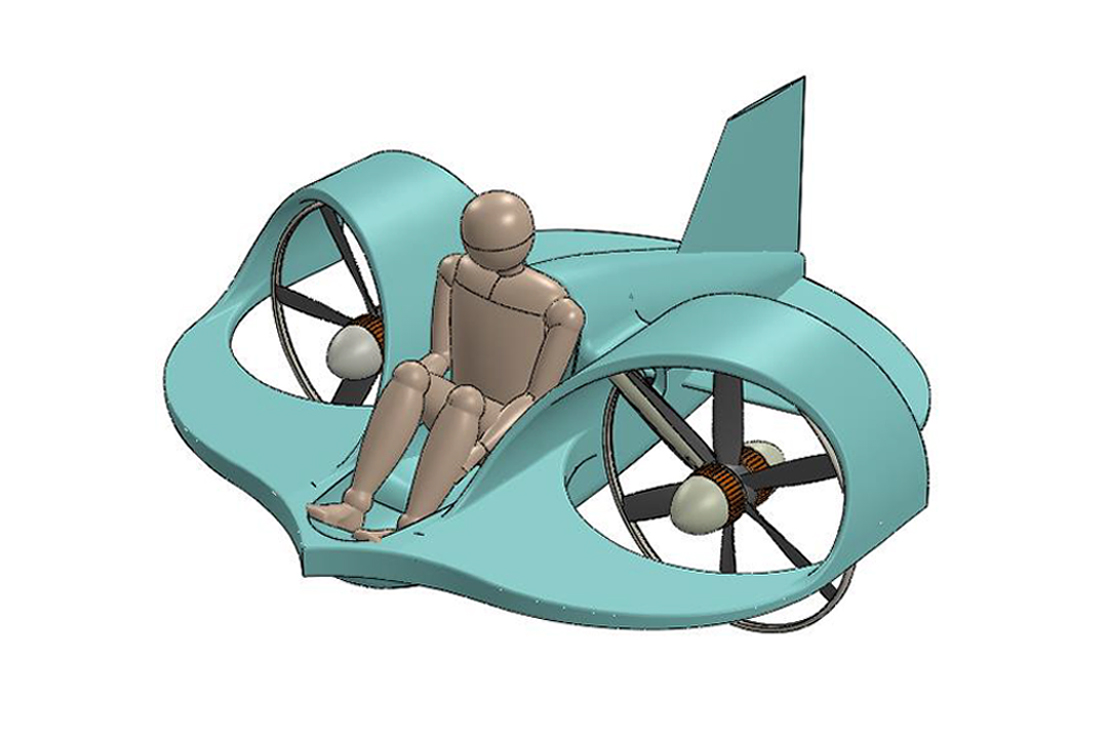
The Rogue is a one passenger recreational eVTOL multicopter aircraft. The aircraft is planned to be piloted and used as a recreational aircraft for short trips. The pilot sits in an open cockpit. A 3-D subscale model of the concept design eVTOL aircraft is above. This is a vectored thrust multicopter aircraft.
The estimated cruise speed at minimum power is 131 km/h (82 mph) and expected cruise speed at maximum power is 335 km/h (208 mph). The stall speed for the aircraft is 126 km/h (78 mph). The range at maximum power is projected to be 48 km (30 miles). The hover endurance is anticipated to be 7.7 minutes. The flight time at minimum power is forseen to be 35 minutes and the flight time at maximum power is proposed at 14.3 minutes.
The aircraft has two shrouded counter-rotating propellers which tilt in all directions, has two electric motors and is powered by lithium-ion batter packs. The empty weight of the aircraft is calculated to be 227 kg (502 lb), with a payload weight of 91 kg (200 lb) and has a maximum takeoff weight of 318 kg (702 lb). The front of the fuselage has a small forward wing which has been designed tohelp to slightly extend the range of the aircraft and for aerodynamic stability. The fuselage is made from carbon fiber composite to give the aircraft a high strength to low weight ratio. The aircraft has one rear vertical stabilizer. The aircraft has fixed tricycle wheeled landing gear.
About the GoFly Competition
The GoFly (2017-2020) Competition was sponsored by Boeing began with its announcement in September 2017, offering a total prize of $2 million USD for the development of personal eVTOL flying vehicles. The competition attracted over 850 contestants from around the world. The competition was structured in three phases, with Phase I focusing on technical specifications, Phase II on flying prototypes and Phase III culminating in a final fly-off to determine the grand prize winner. The final fly-off took place in the fall of 2019. The final $1 million USD grand prize was never awarded.
Specifications:
- Aircraft type: Passenger eVTOL multicopter (concept design)
- Piloting: 1 pilot
- Cruise speed (minimum power): 131 km/h (82 mph)
- Cruise speed (maximum power): 335 km/h (208 mph)
- Stall speed: 126 km/h (78 mph)
- Range (maximum power): 48 km (30 miles)
- Hover endurance: 7.7 minutes
- Fight time (minimum power): 35 minutes
- Flight time (maximum power): 14.3 minutes
- Empty weight: 227 kg (502 lb)
- Payload weight: 91 kg (200 lb)
- Maximum takeoff weight: 318 kg (702 lb)
- Propellers: 2 shrouded propellers (counter-rotating propellers which tilt in all directions), 4350 RPM
- Electric motors: 2 electric motors, shaft power 78 kW each
- Power source: Li-Ion batteries, 91 kg (200 lb)
- Fuselage: Carbon fiber composite
- Wings: The front of the fuselage has a small forward wing which has been designed tohelp to slightly extend the range of the aircraft and for aerodynamic stability
- Window: Open cockpit
- Tail: 1 vertical stabilizer
- Landing gear: Fixed tricycle wheeled landing gear
- Safety features: Distributed Electric Propulsion (DEP) uses multiple propellers or electric ducted fans, each powered by electric motors, to increase safety through redundancy. If one or more components fail, the remaining ones can still ensure a safe landing. There are also redundancies of critical components in the sub-systems of the aircraft providing safety through redundancy. Having multiple redundant systems on any aircraft decreases having any single point of failure. Has shrouded propellers for additional safety.
Related Aircraft:
- Bivect Air Air Rider (concept design)
- Bivect Air Ariel (concept design)
- Bivect Air Nymbus (concept design)
- Bivect Air Odyssey (concept design)
- Bivect Air Tandem-X (concept design)
- Bivect Air Twister (concept design)
Company Insights:
Resources:

Recent Pages
- Vight V1 (concept design)
- E-HAWK Technology Group Eagle Air Cargo (prototype)
- E-HAWK Technology Group Eagle Air Taxi
- LODD Hili (prototype)
- Zuri Cargo (production model)
- Nanyang Technological University Singapore NTU TD1 (technology demonstrator)
- Honda Aircraft Company F1 (technology demonstrator)
- Aerotrem Technologies Urban Rescue Mark IV (concept design)
- Aerotrem Technologies Urban Rescue Mark III (concept design)
- Aerotrem Technologies Urban Rescue Mark I (concept design)